
Some material investigations begin not in the studio, but in an encounter with data.
The earliest impulses behind Spectral Taxonomy did not emerge from images of coral reefs, but from reading the scientific timelines documenting mass coral bleaching events. Tables of dates and intervals between bleaching episodes began to read less like statistics and more like a record of gradual disappearance.
Standing before this information, I became interested in a question:
What happens when environmental data is translated into a material language?
Rather than illustrating coral ecosystems directly, the work attempts to interpret the structure of collapse itself. The result is a body of paper-based works in which colour, layering, and surface damage operate as a taxonomy of loss.
In this sense the works function less as representation and more as material translation.
Reading the Data
The research underpinning Spectral Taxonomy draws on data published by NOAA’s Coral Reef Watch and the Great Barrier Reef Marine Park Authority, both of which document the increasing frequency of global coral bleaching events.
Bleaching occurs when coral polyps expel their symbiotic algae, known as zooxanthellae, in response to elevated ocean temperatures. Without these algae the coral loses both colour and a primary source of energy, leaving behind a pale skeletal structure.
Over the past several decades, major bleaching events have been recorded with increasing frequency:
1998
2002
2016
2017
2020
2022
2024
2025
What held my attention was not only the occurrence of these events, but the shortening intervals between them. The rhythm of the data suggested a structure built through recurrence rather than singular catastrophe.
This compression of time began to suggest a visual and material form. Instead of producing a single image, the work would be constructed through repeated units. A structure capable of registering accumulation, disruption, and instability.
From this reading the lamella emerged.
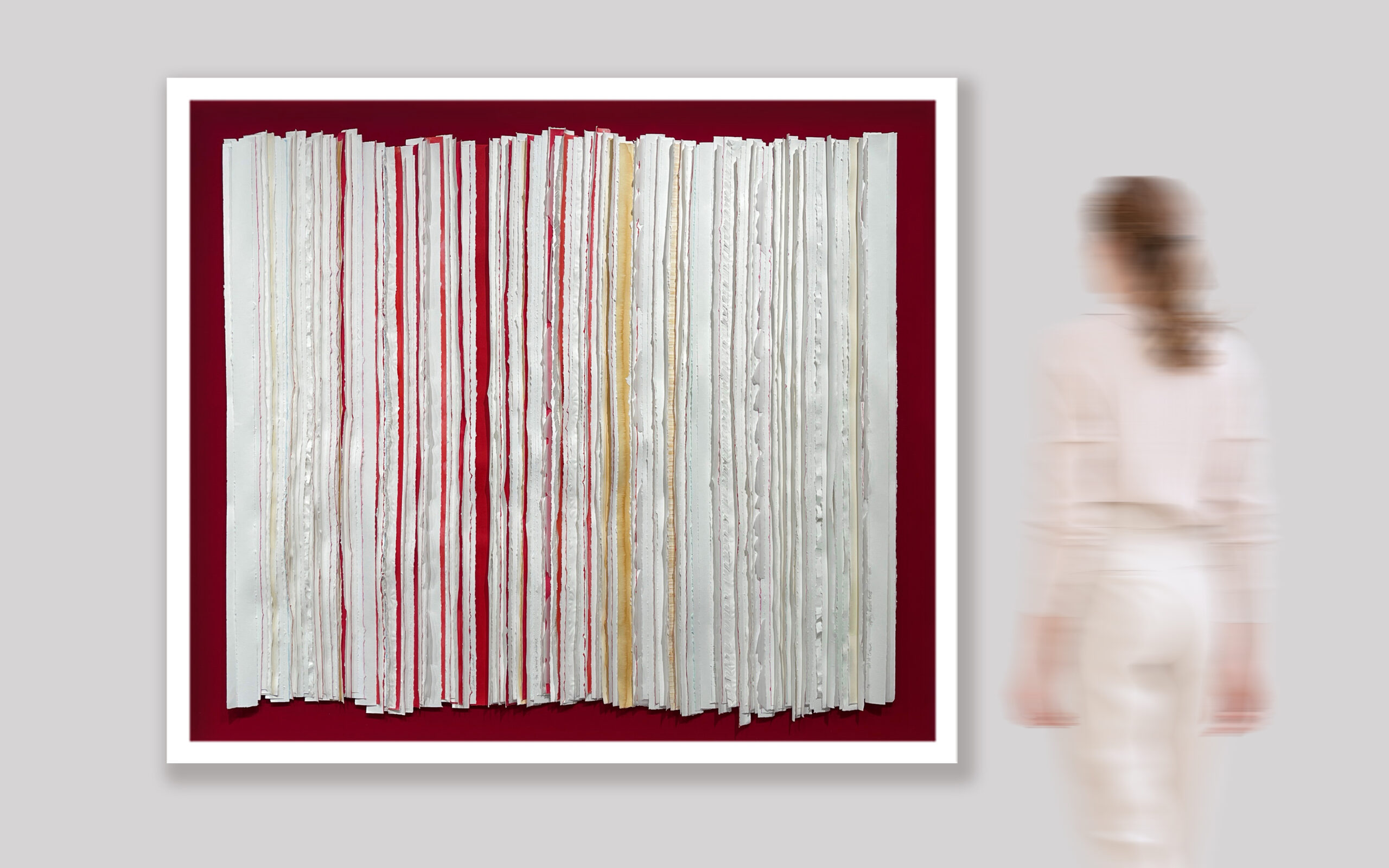
Spectral Taxonomy installation views
layered paper lamellae on archival support
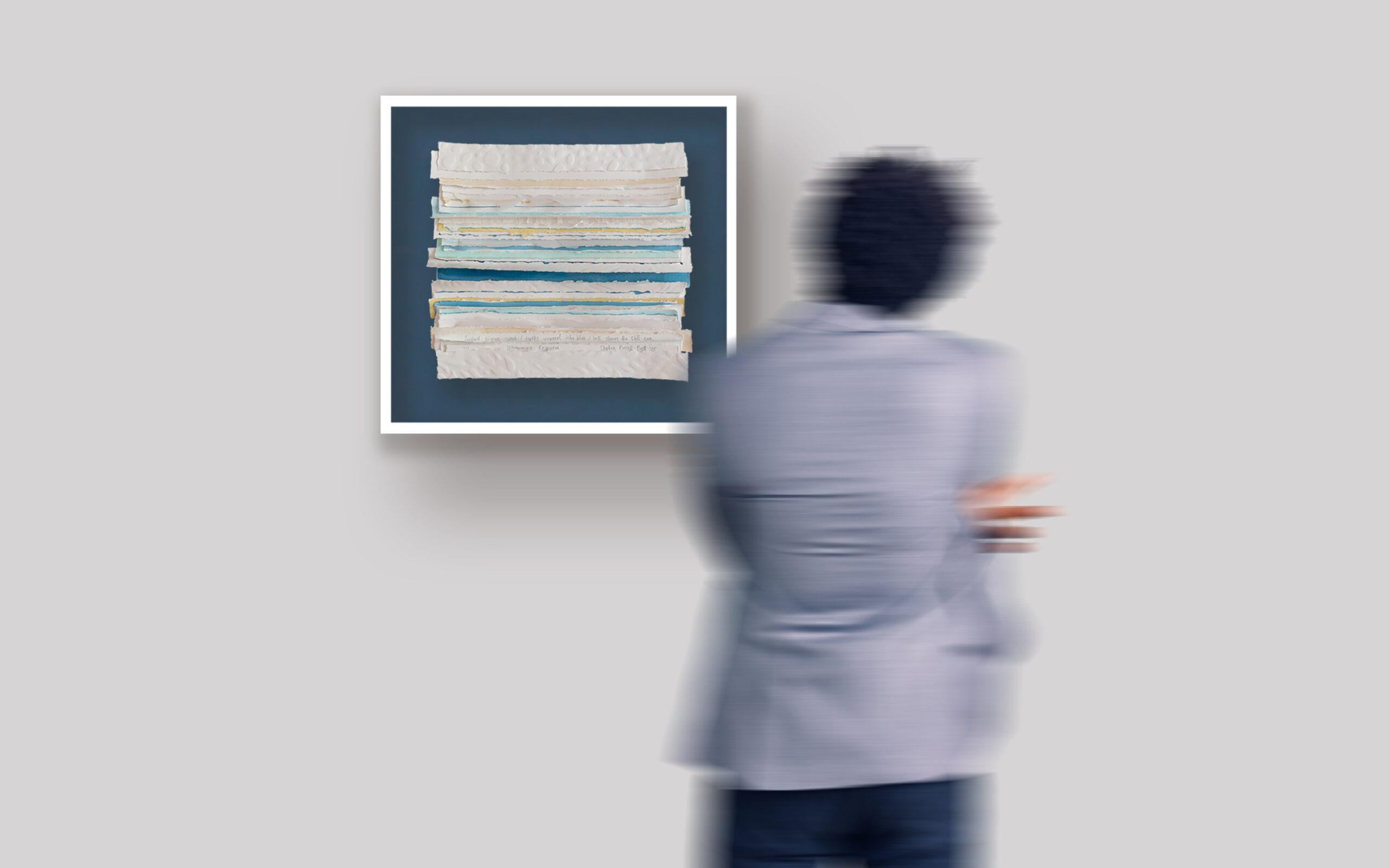
Spectral Taxonomy installation views
layered paper lamellae on archival support
Translating Intervals
The central device of the series is the lamella, narrow vertical strips of paper layered sequentially across the surface of the work.
Each lamella functions as a marker within a growing field of accumulated transformation. When assembled collectively, the strips create a stratified surface that echoes both geological formation and archival indexing.
Rather than representing coral reefs directly, the work adopts a structural logic derived from the data itself. The lamellae create a field in which repetition and variation operate simultaneously: order is visible, but never entirely stable.
In this way the work translates the temporal structure of bleaching events into a material system.
“The rhythm of the data suggested a structure built through recurrence rather than singular catastrophe.”
Surface as Record
Paper was chosen deliberately. Unlike rigid materials, paper records transformation easily. Water staining, abrasion, tearing, and pigment absorption remain visible rather than disappearing beneath the surface.
Early studio tests were more regular and diagrammatic. The lamellae aligned too precisely and the surfaces appeared overly resolved, resembling charts rather than material witnesses. Introducing water, pigment staining, and physical abrasion began to interrupt that clarity.
The paper resisted control in productive ways. Pigment spread unpredictably, deckled edges softened alignment, and layered surfaces refused complete uniformity.
These deviations became central to the work. They shifted the lamellae away from pure indexing and toward a structure capable of registering instability.
Through this process the surface begins to behave less like an image and more like a record of material change.

Spectral Taxonomy – lamella colour studies
pigment, staining, and surface manipulation on archival paper
Series Structure
While individual lamellae record surface change, the works also develop through decisions made across the series as a whole.
Early pieces were more regular and tightly ordered. Over time the lamella fields became less uniform, allowing slight deviations in alignment, colour saturation, and paper tension.
These shifts were not planned in advance but emerged gradually through making. Each work introduced small adjustments that altered how the system behaved in the next.
In this way the series evolved not as a fixed format, but as an accumulating set of material responses to the same underlying question.
Encountering the Work
At a distance the works initially appear as ordered vertical systems. The lamellae align into what reads as a structured field.
Closer viewing unsettles this clarity. Torn edges, staining, and slight variations in pressure begin to separate the surface into individual elements.
The eye moves between structure and fragility, between the readability of the system and the instability embedded within its material.
This shifting register is central to the encounter.
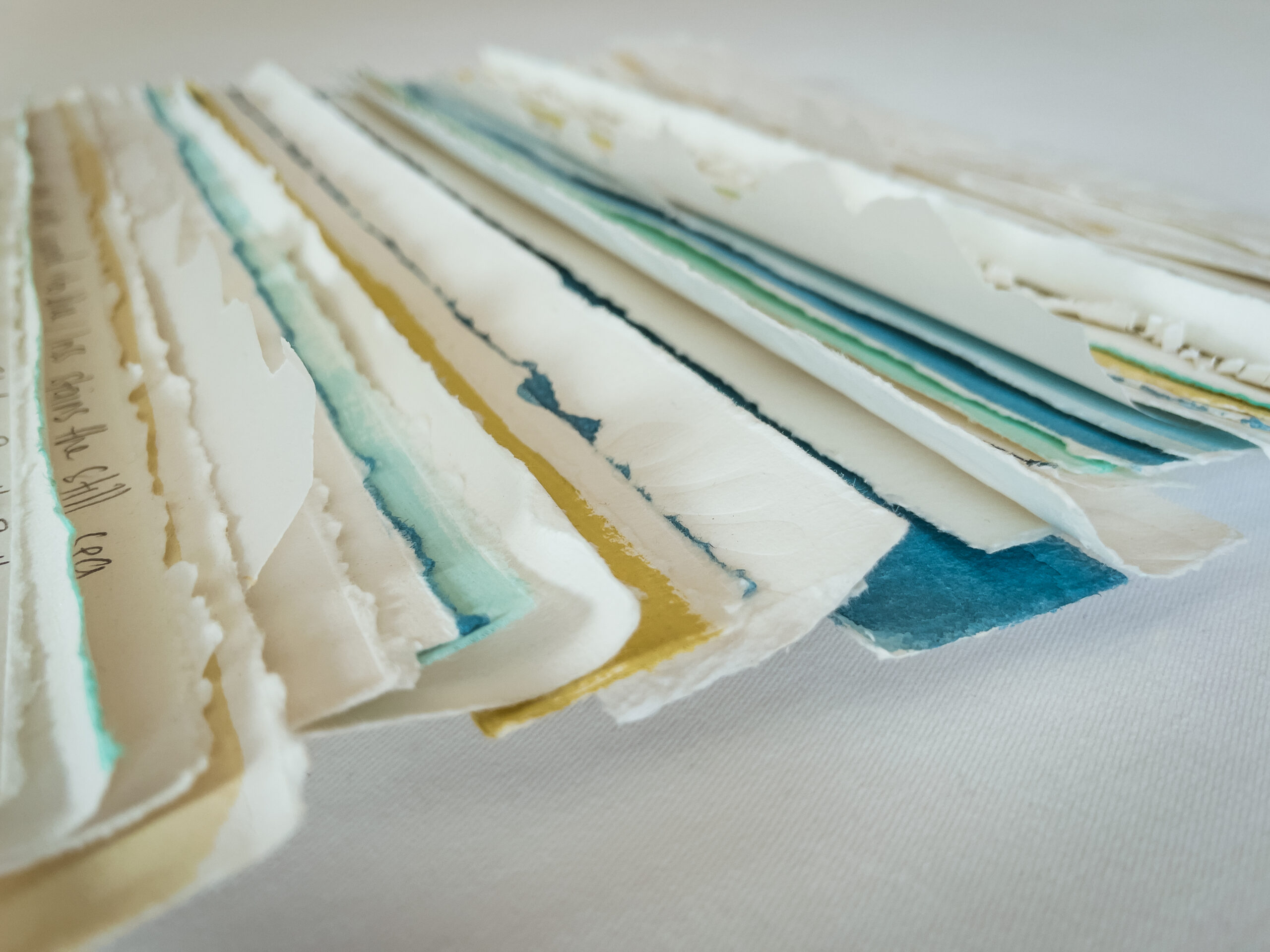
Studio process studies
surface tests exploring lamella construction, staining, and material erosion
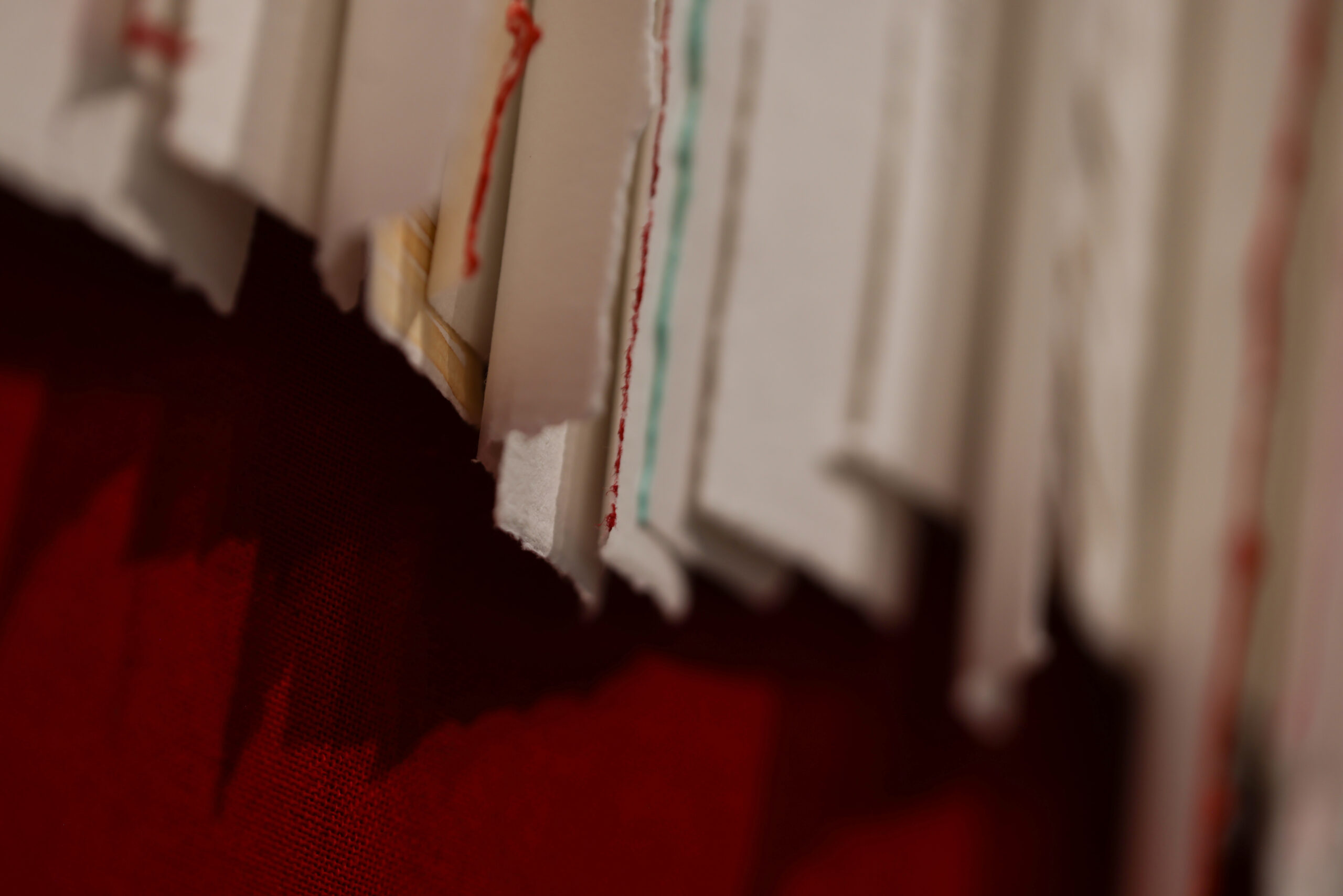
Studio process studies
surface tests exploring lamella construction, staining, and material erosion
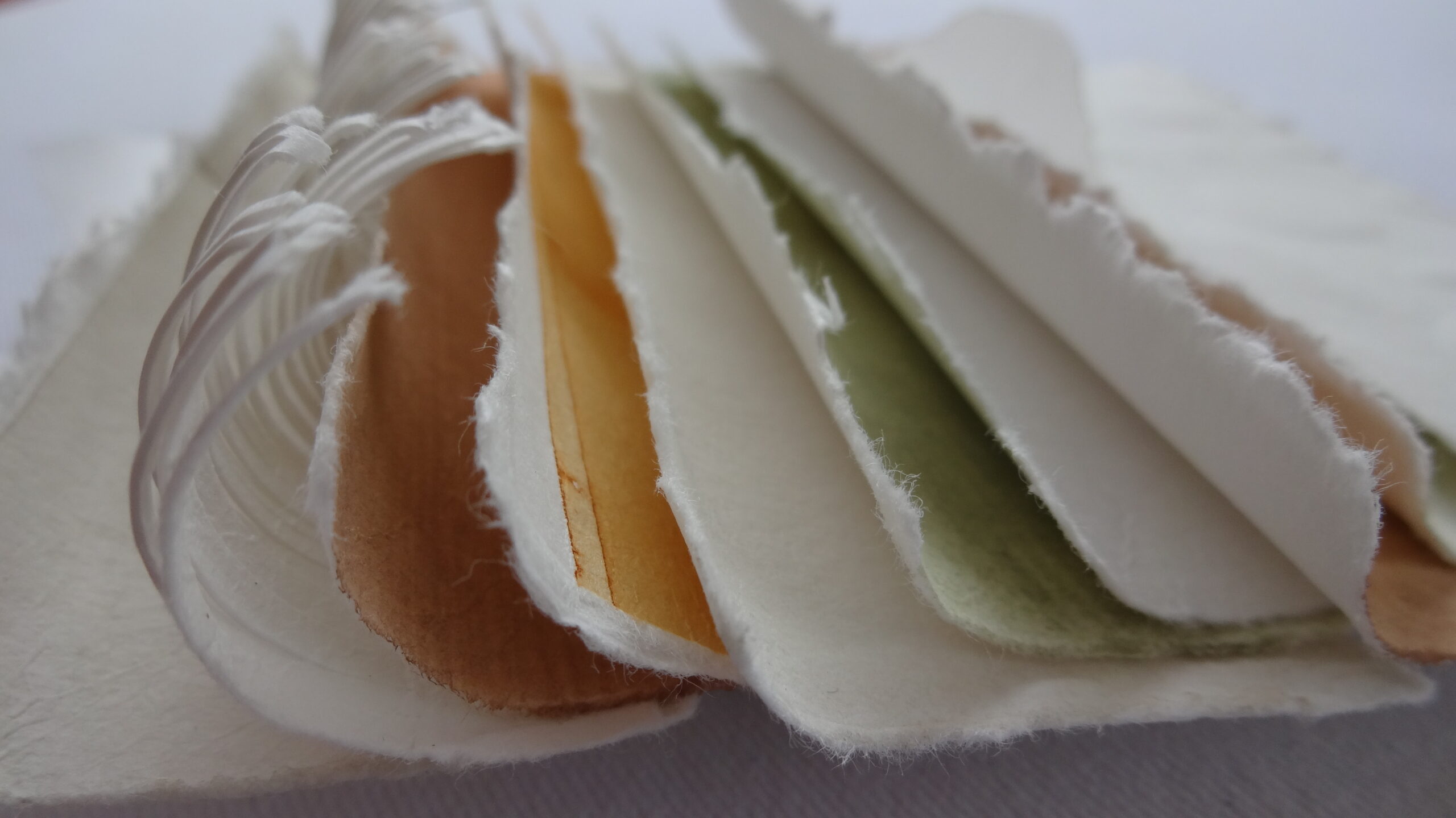
Studio process studies
surface tests exploring lamella construction, staining, and material erosion
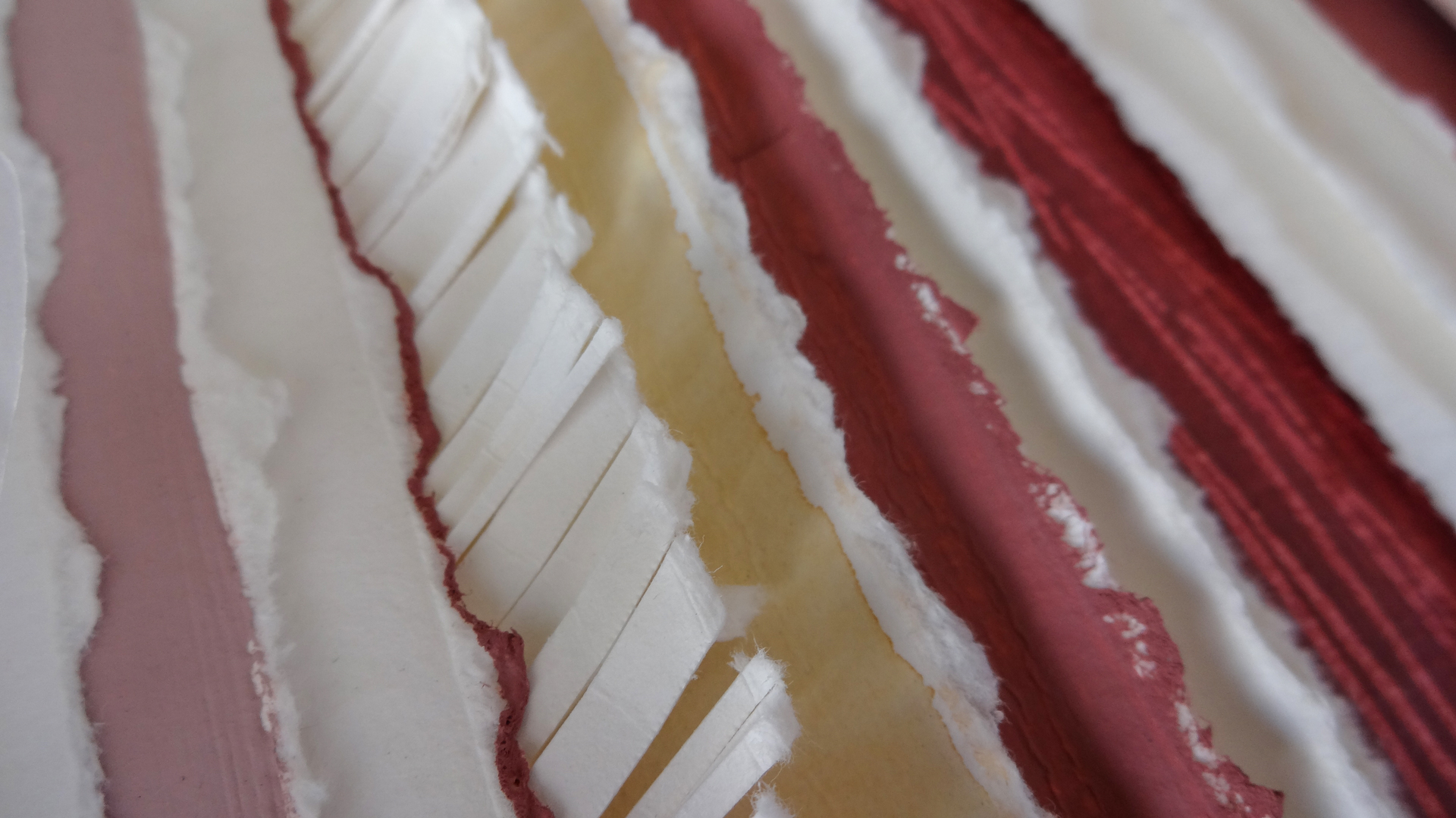
Studio process studies
surface tests exploring lamella construction, staining, and material erosion
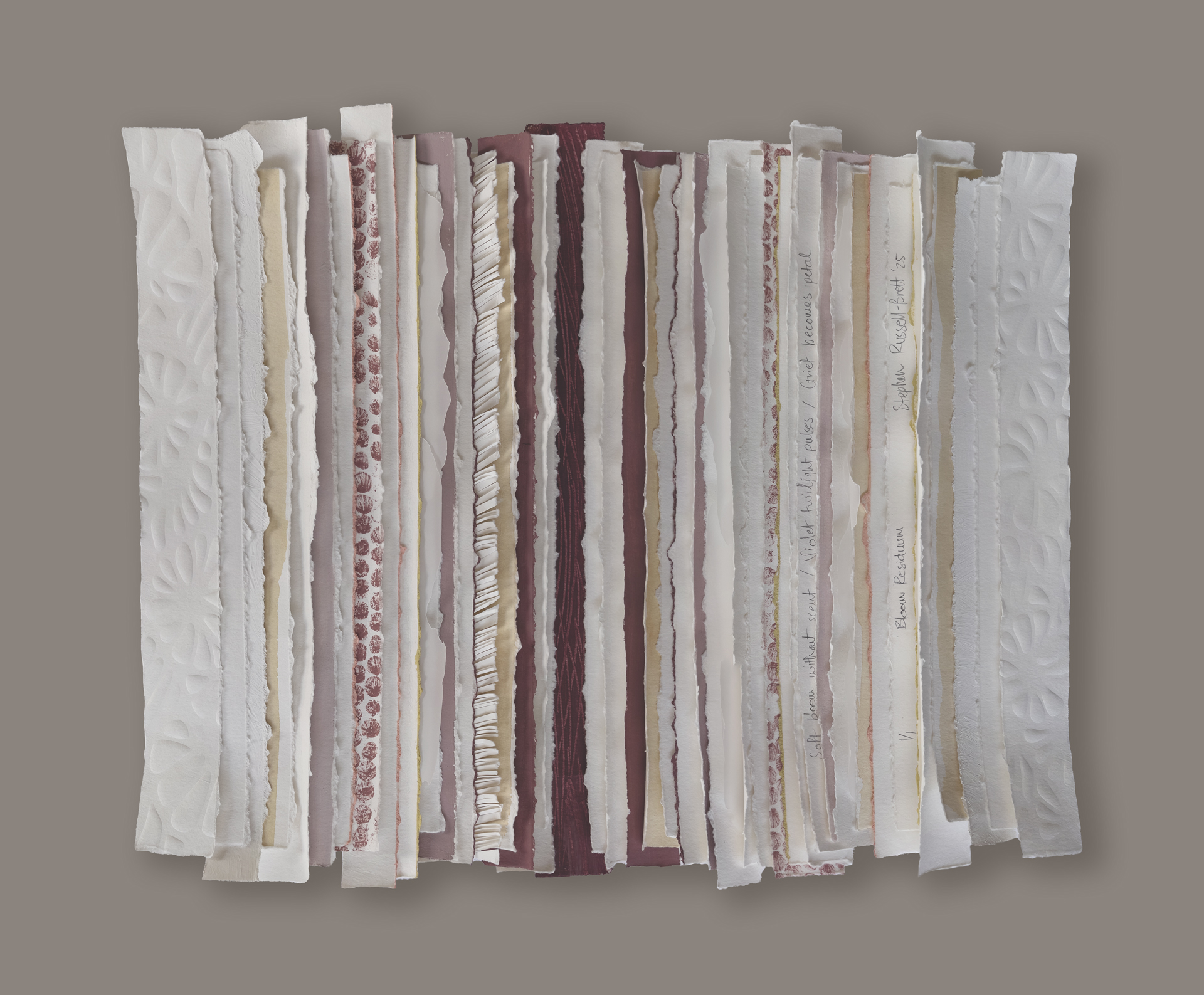
Spectral Taxonomy
layered paper lamellae with pigment and water staining
Material Elegy
I use the term material elegy to describe works that do not narrate loss directly, but register it through surface, structure, and gradual transformation.
Rather than representing disappearance through image or story, the works allow loss to accumulate materially – through staining, erosion, and instability within the paper itself.
Elegy as a literary form has historically been expected to move the mourner toward resolution or consolation. These works depart from that convention. Instead of resolving grief, they remain with the instability of what is vanishing.
In Spectral Taxonomy, colour appears provisional and fragile – unevenly absorbed into the paper, subject to further change, never fully resolved. The lamellae hold their vertical order, but each strip carries slight differences in pressure, staining, and erosion.
Standing before them, the viewer encounters not an image of disappearance, but a structure that slowly unravels into individual lamellae. Each carrying its own trace of pressure, colour, and time.
Further Reading
Fractured Liminality – Personal Elegies
Explore the full body of work →
stephenrussellbrett.com/fractured-liminality
Studio Note
This text forms part of an ongoing studio research archive documenting the conceptual and material development of the Material Elegies body of work.
< Previous Entry
Fractured Liminality: Folding, Fragmentation, and the Construction of Memory
Next Entry >
Finding Treasure in the Scraps