
Veil of Erasure: 135 Months, 135 Breaths
How temporal acceleration became paper architecture
Studio Journal | March 2026
The first time I saw 135 as more than a number, I was standing in my studio surrounded by printouts of coral bleaching timelines – global events, regional collapses, years that refused to behave like stable intervals. 1998. 2002. 2016. 2017. Gaps that stretched, then snapped shut.
My breathing changed. Not because the number was large, but because it was small. What should be measured in centuries – catastrophic events separated by recovery periods long enough for reef systems to rebuild – was now compressed into something I could count on my fingers. A child born in 1998 would witness four mass bleaching events by age 19.
Rather than calculating a statistical average, I compressed these irregular and accelerating intervals into 135 lamellae, a mnemonic unit of loss, not a chronological one. A structure to hold what numbers alone cannot.
That’s when I understood: the violence isn’t just the bleaching. It’s the acceleration. The compression of geological time into biographical time.
135 became a heartbeat. A structure. A breath I couldn’t release.
Veil of Erasure began there – in that moment of held breath, standing between data and grief.
On April 15, 2024, NOAA (in partnership with the International Coral Reef Initiative) confirmed the world is in the midst of its fourth global coral bleaching event. From January 2023 to September 2025, bleaching-level heat stress impacted ~84.4% of the world’s coral reef area. Mass coral bleaching has been documented in at least 83 countries and territories.
The ongoing event is the biggest to date. The previous record was during the third global bleaching event (2014-2017), when 68.2% of reef area experienced bleaching-level heat stress. The first and second events occurred in 1998 and 2010.
The intervals keep shrinking. The rhythm has broken.
When Paper Becomes Reef
I’ve worked with paper for years, but Veil demanded something different. Not paper as substrate. Paper as participant.
Paper, like coral, is lamellar – layers built over time, each carrying marks of its making. Paper, like coral, is vulnerable to water, heat, stress. Paper, like coral, can be bleached. The material parallel wasn’t metaphor. It was correspondence.
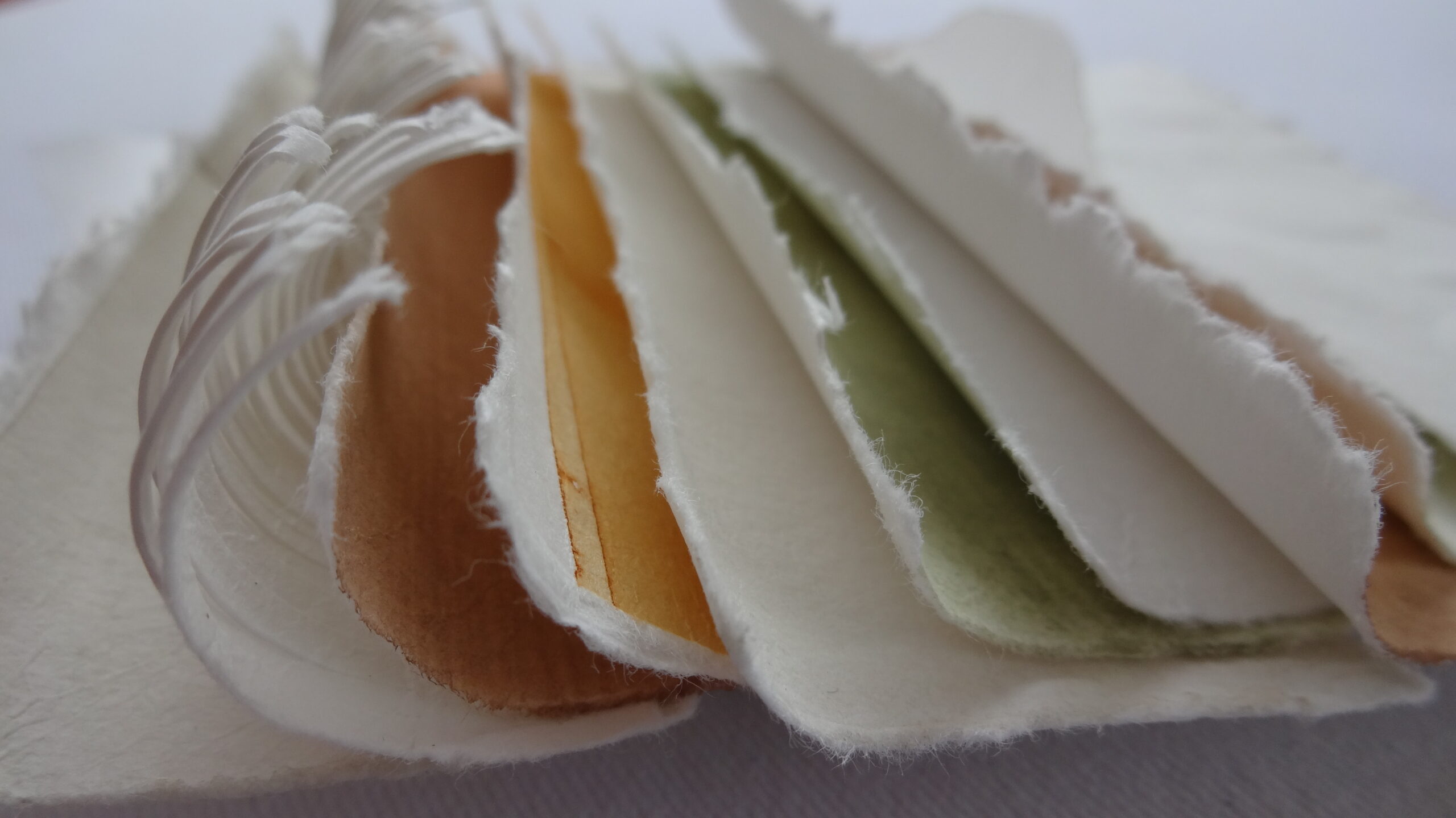
I chose Hahnemühle Britannia (300gsm) as my primary substrate – it buckles beautifully when water-damaged, the fibers swelling and warping, holding the memory of liquid encounter. For contrast, I incorporated vellum (which tears cleaner, more surgical) and three varieties of Japanese washi: kozo (strong, fibrous), gampi (translucent, catches light), and mitsumata (soft, with natural deckle edges I enhanced through controlled bruising).
Each of the 135 lamellae underwent what I call processes of correspondence – not representing coral stress, but embodying it.
Tea Staining
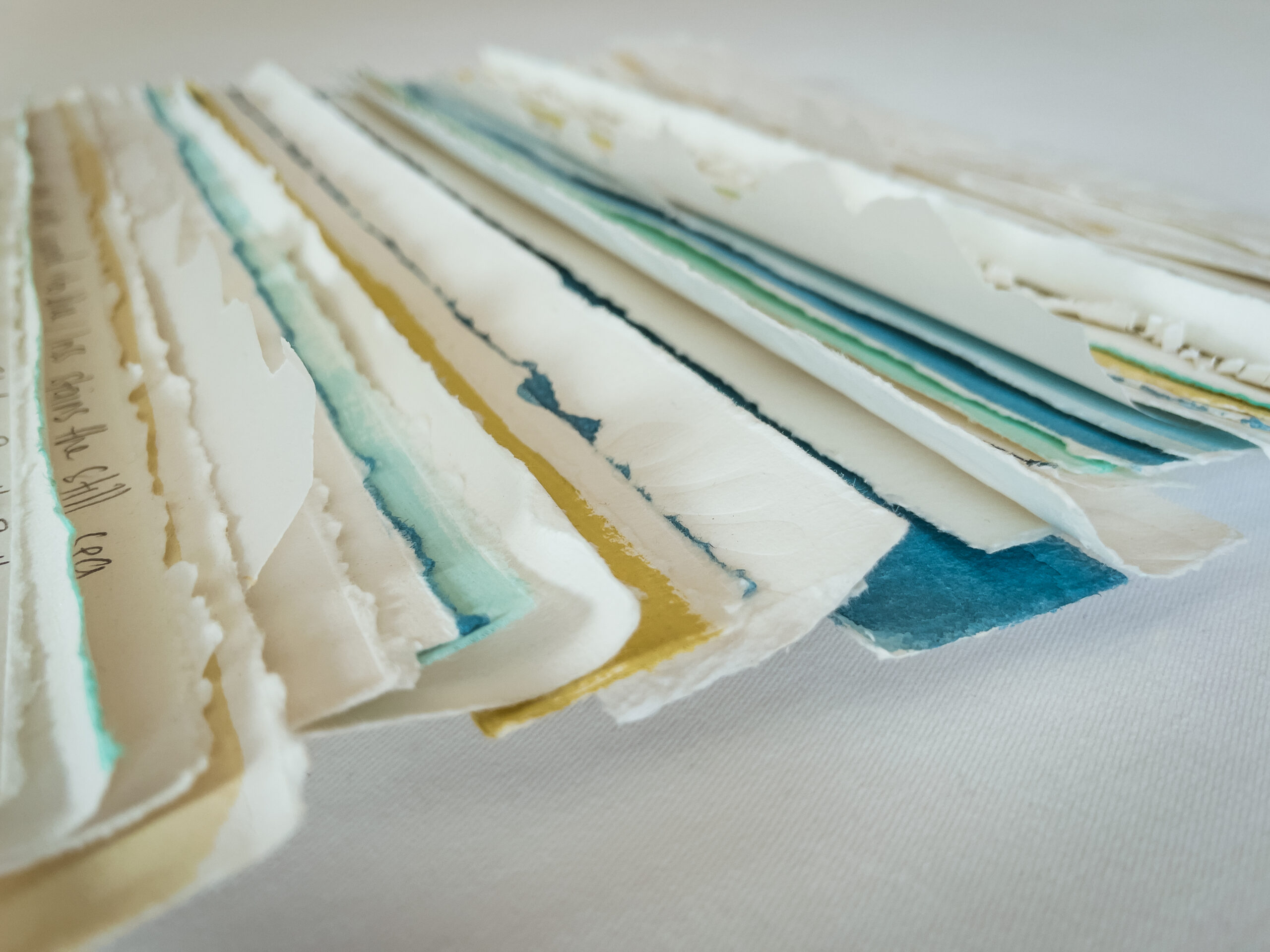
I brew strong black tea, sometimes mixing varietals (black, green, oolong) for different oxidation rates. I cool the tea to specific temperatures that mirror thermal thresholds: 28-30°C, the range where coral begins expelling zooxanthellae. Each sheet soaks for measured intervals. The tannins oxidise over days, weeks, slow staining that echoes slow warming.
Some sheets I stain once. Others I return to repeatedly, building layers of exposure like coral experiencing multiple thermal events. On a few sheets, I use resist techniques – applying wax before tea staining, creating subtle patterns visible only upon close inspection.
In later stages of the work, rooibos tea replaced black tea on select lamellae, producing a deeper burnt umber tone and a softer oxidative edge. Rooibos staining appears across several sheets, not as accent, but as tonal shift within the broader bleached field.
The colour isn’t decoration. It’s a temporal record.
Gesso Textures
Gesso application represents calcification – the skeletal structures coral builds. I apply gesso in varying thicknesses, sometimes building up layers to create dimensional relief. The white-on-white creates subtle shifts in how light catches the surface.
What remains after living tissue dies.
Embossing
Using custom plates I designed based on coral polyp surface topology, I blind-emboss patterns into dry paper. Some impressions are shallow (0.5mm), others deep (1.5-2mm, requiring significant pressure). The multi-level embossing creates ghost architectures—raised structures that cast shadows, revealing themselves only when light rakes across at certain angles.
You have to emboss with significant pressure. The paper remembers.
Japanese Washi Techniques
On select sheets, I incorporated traditional Japanese approaches: nikawa (glue) sizing that creates translucent washes, burnishing techniques that create contrast between matte and reflective surfaces. The asanoha (hemp leaf) pattern appears on the final sheet, ultra-fine embossing that references traditional reverence for impermanence.
Lace Spray Patterns
On three strategic sheets (positions 32, 80, 118), I applied ghostly lace patterns through natural coral specimens, using diluted pigments misted to near-transparency. These skeletal reef structures appear and disappear depending on light and viewing angle, trace memories of living architectures now reduced to pattern.
Subtle Blue-Green Memory
On four sheets, I applied barely perceptible blue-green tints, extremely diluted washes, microscopic stippling, transparent layers along edges. These suggest trace memory of healthy coral, the chromatic vitality that zooxanthellae once provided. You have to look closely to see them. They’re almost not there.
Like the reefs themselves.
Strategic Tearing
This was the hardest to learn. Tearing paper feels violent. But coral bleaching is violent, calcium architectures fracturing under thermal stress, centuries of construction collapsing in weeks.
I tear at stress points – where water damage weakened fibers, where embossing thinned the structure. I tear slowly, deliberately. Each tear is a decision to let the material fail where it wants to fail.
Some sheets I leave intact. Others barely hold together. The field needs both, the not-yet-broken and the already-gone.
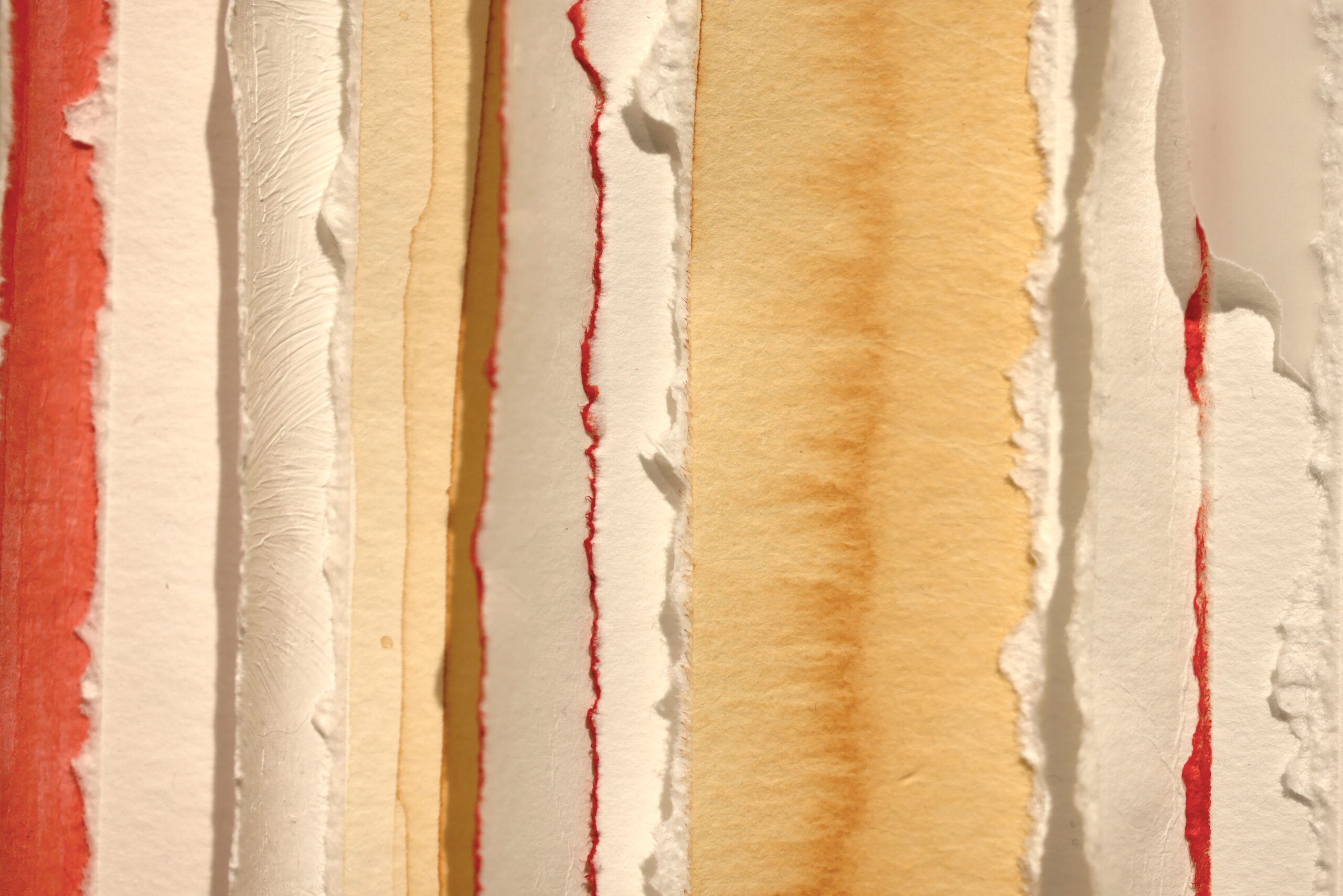
Material behaviour under stress
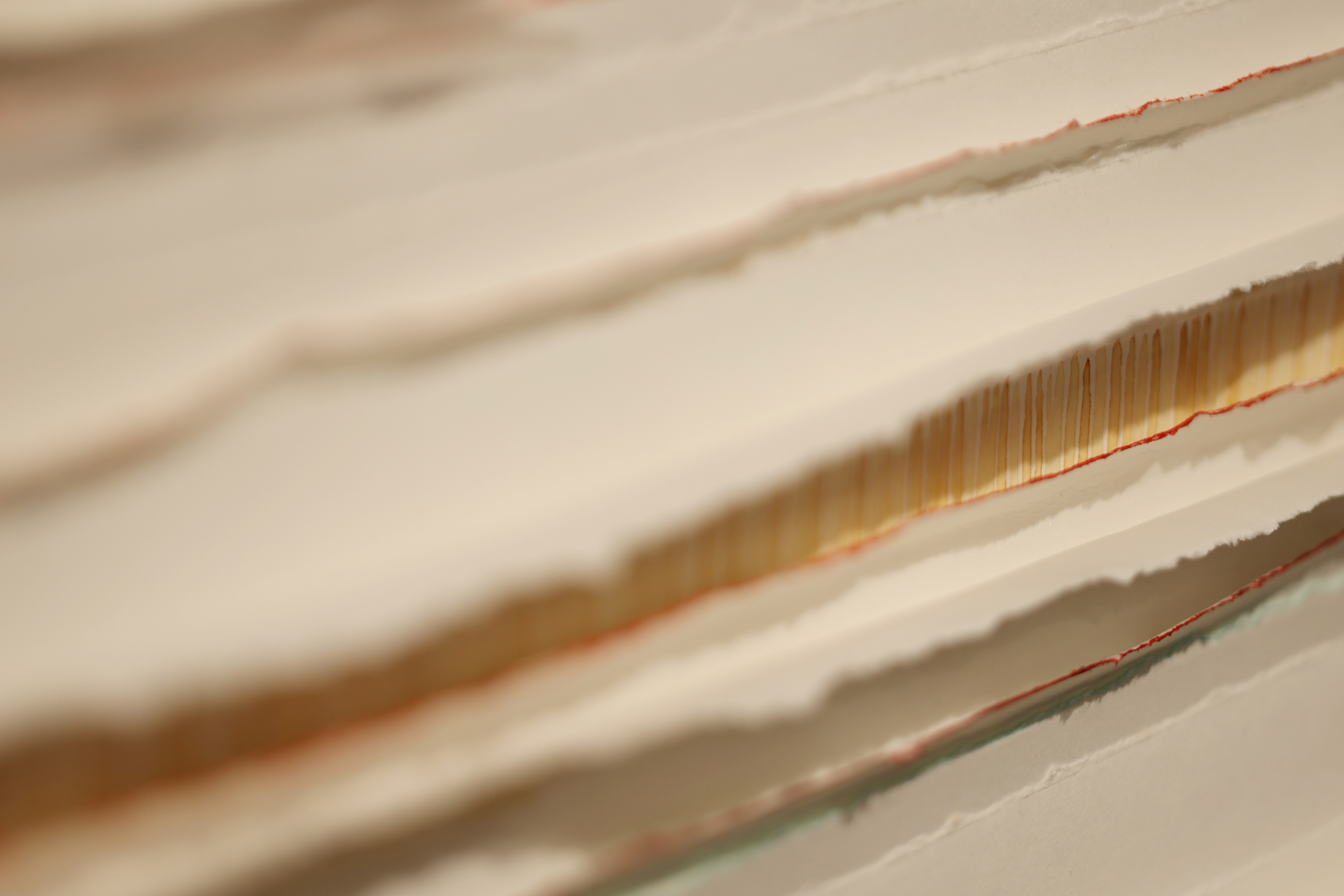
Material behaviour under stress
The Architecture of Absence
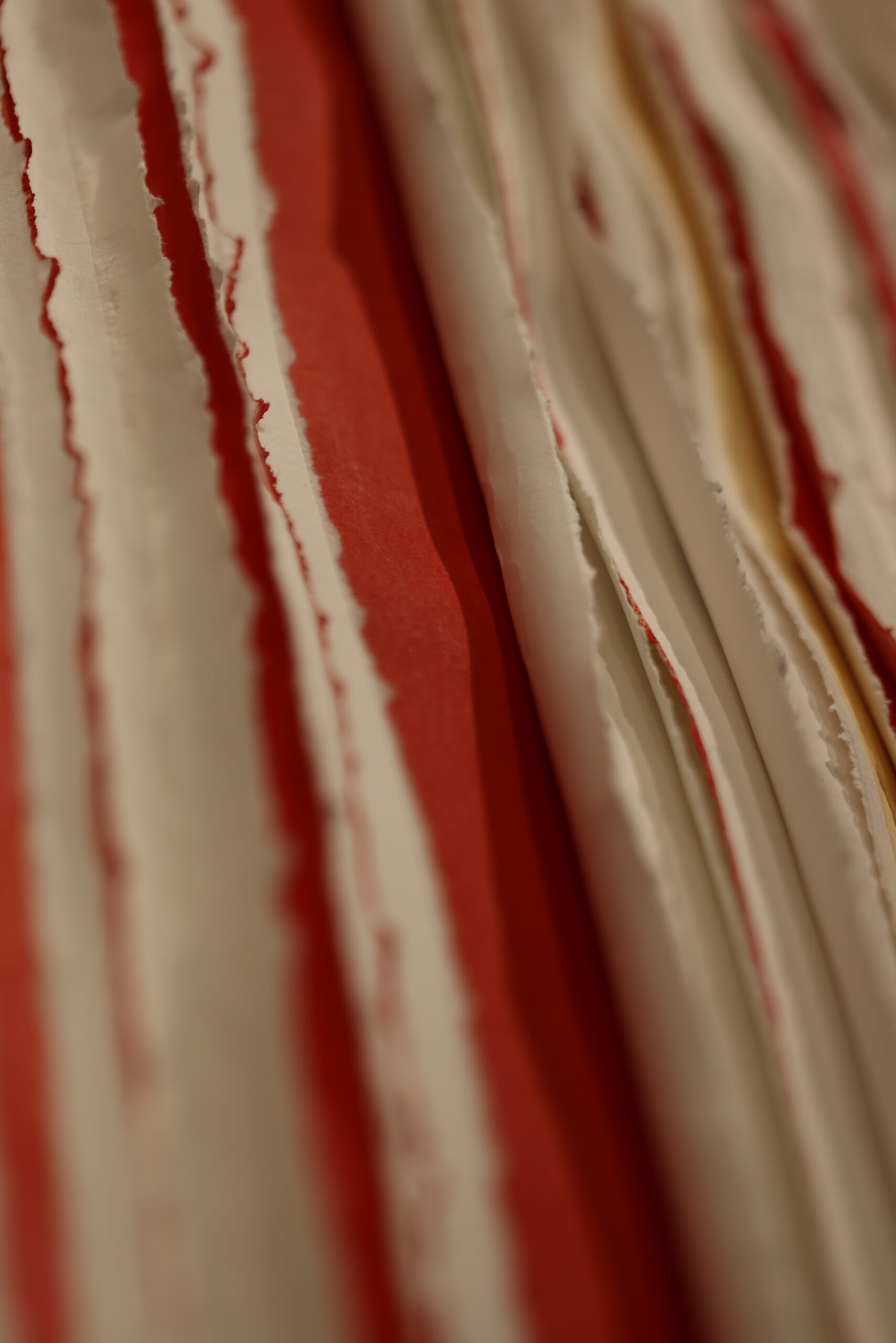
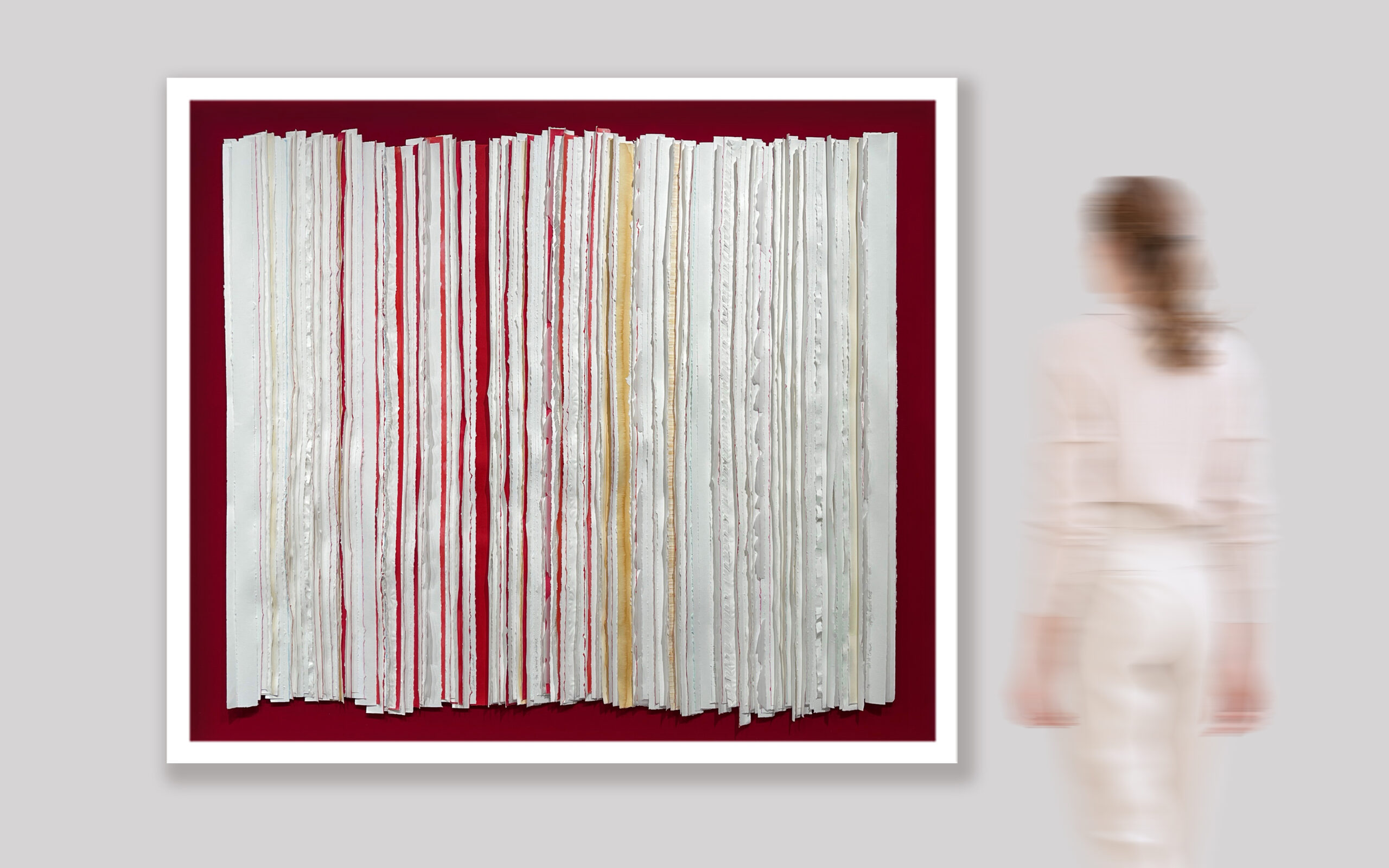
135 lamellae. Each approximately 123cm × 4cm, though dimensions vary with tearing. Suspended within a deep shadow box frame (170 × 154 × 7.5cm), mounted against 100% cotton backing dyed a specific red I spent months finding.
Not crimson. Not scarlet. Something between arterial blood and warning sign.
The lamellae float against the red backing. How they’re fixed remains hidden, the construction invisible, the mystery intact. When light moves across the surface, shadows shift. What appears static reveals depth. The work breathes.
Four Elevation Levels
The lamellae suspend at four distinct depths:
- Base layer (flush with backing)
- Secondary elevation (3mm forward)
- Tertiary elevation (5-7mm forward)
- Top layer (8-12mm forward)
This dimensional layering creates complexity, you cannot see the full work from one angle. You must move, shift position, let light reveal what was hidden. Some sheets catch light directly. Others exist in shadow cast by sheets in front of them.
Four Negative Spaces
At positions 29, 43, 88, and 98, there are no sheets. Just red backing. Compositional voids. Absences that function as presence.
Loss visible as gap.
Two Red Interruptions
Most sheets are pale—tea-stained whites, bone, cream, the faintest blues where I applied those ghost-memories of healthy coral. A field of bleached absence.
But at position 51 (the reciprocal golden ratio point, 38.2% across the composition), a red lamella interrupts the bleached field. The surface is stripped back – flat red pigments layered without embossing, without relief. The colour absorbs rather than reflects light. It refuses decoration.
And at position 83 (the golden ratio point, 61.8% across), a second red lamella appears, this time through absence rather than addition. The sheet was fully stained with rooibos tea, then torn back to expose a raw white edge. The resulting burnt umber surface carries the memory of saturation, while the exposed white reads as fracture.
I agonised over these placements. Two red interruptions among 133 pale sheets. Too obvious? Too symbolic?
But I kept returning to the same truth: every dataset has an outlier. Every timeline has a rupture point. Every field of loss has a wound that won’t close.
The red lamellae function as both, the moment before collapse, and the memory that persists after.
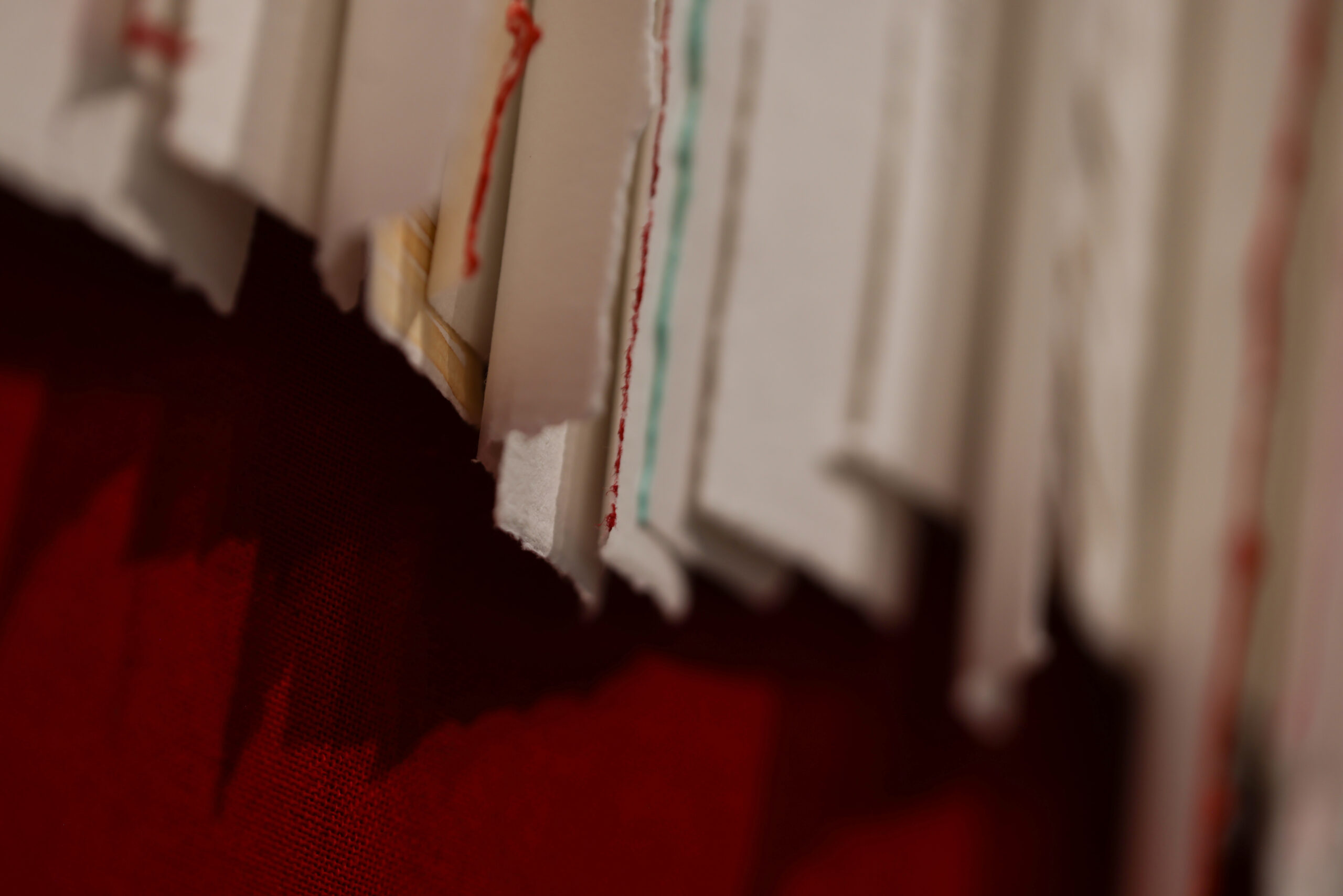
Lamellae field against red ground
Three Breaths of Text
Hidden across three lamellae (positions 50, 63, 99), almost invisible unless you’re close enough to see the embossed surface, is a haiku:
Colours surrender
To the warming embrace
Coral turns to ghost
I wrote this after reading about zooxanthellae expulsion, how the algae that give coral its colour literally abandon their host when temperatures rise, leaving behind white calcium skeletons. “Warming embrace” was deliberate irony. The ocean that sustains also destroys.
The haiku fragments across three sheets, positioned at irregular intervals. You have to search for it. This felt important, text shouldn’t announce itself. It should be discovered, the way you’d find a message in an archive you weren’t sure anyone wanted read.
The form itself – haiku’s 5-7-5 syllabic structure – imposes constraint. You cannot elaborate. You cannot explain. You must distil.
Grief needs this sometimes. A form that holds but doesn’t overflow.
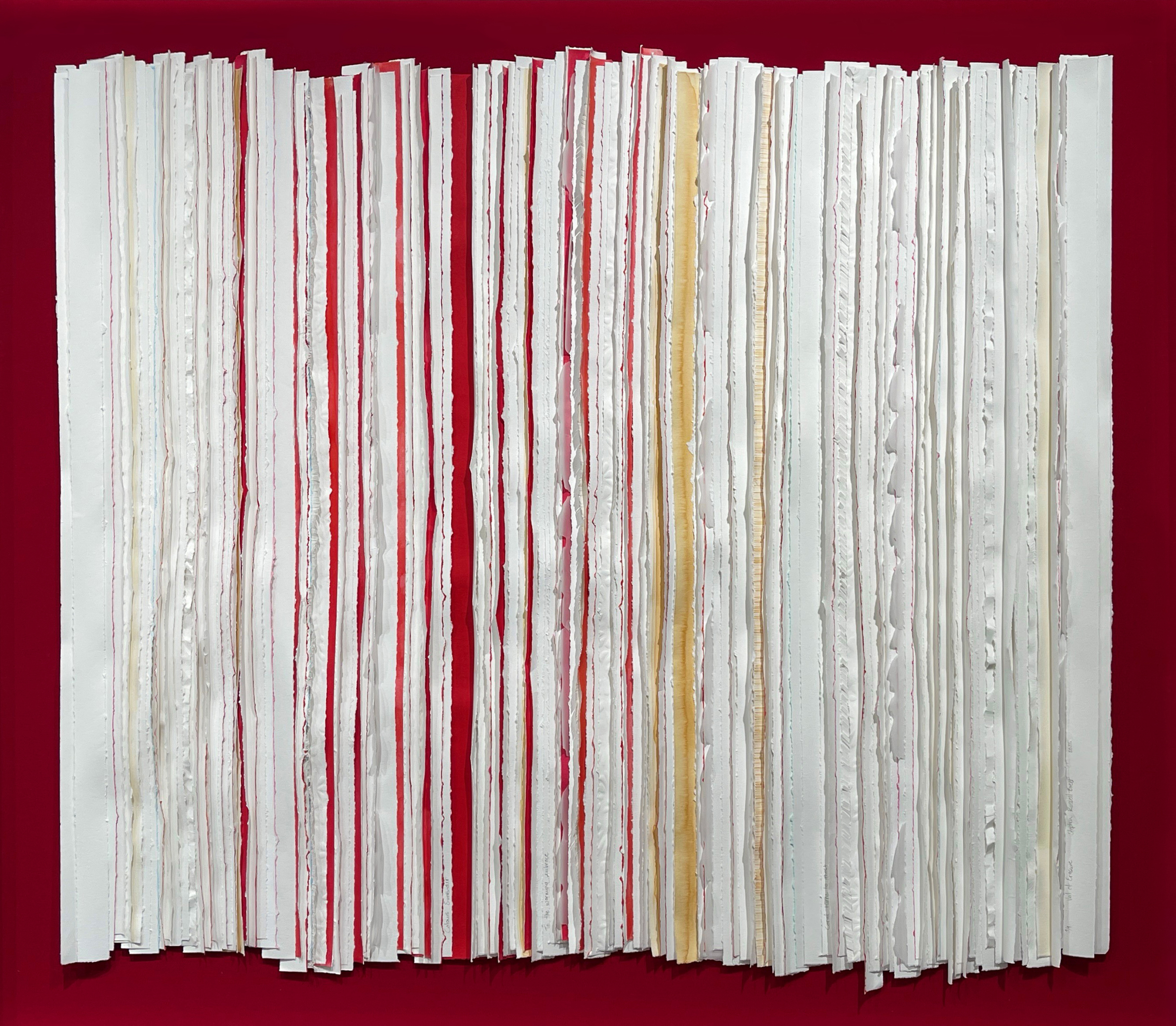
Lamellae field against red ground
Lamellae field against red ground
Mujō: Impermanence as Practice
When I was researching Japanese paper traditions, I encountered the concept of mujō (無常) – usually translated as “impermanence” or “transience,” but carrying deeper philosophical weight. It’s the Buddhist recognition that all things are in constant flux, that nothing remains static, that loss is built into existence itself.
Mujō isn’t pessimistic. It’s clear-eyed. It says: this will not last, and that’s not failure, that’s reality.
I realised Veil of Erasure is a mujō practice. The work doesn’t try to preserve coral reefs. It doesn’t offer solutions or hope. It acknowledges what’s disappearing and creates space to witness that disappearance without turning away.
The paper itself embodies mujō – tea stains will continue to oxidise, edges will yellow with age, the work will slowly fade. Even behind archival-grade glass, even in climate-controlled spaces, paper carries its own mortality.
I’m making archives that are themselves impermanent. Records that will fail.
The Shadow Box as Threshold
The dimensional depth of the shadow box (7.5cm) was a late decision that changed everything. Initially, I’d planned a flat frame. But flat felt wrong, too much like illustration, not enough like space.
The shadow box creates literal threshold. You look into the work, not just at it. The lamellae suspend at different depths, creating layers you can’t fully see from one angle. You have to move. Shift your position. Let light reveal what was hidden.
This parallels how we encounter loss – never all at once, never completely. Always partial. Always requiring return, re-looking, staying with what resists easy comprehension.
The archival-grade glass creates a final barrier. While not museum glass – prohibitive at this scale – the glazing nonetheless functions as separation. Reflective. Distancing. Unbreachable.
You cannot touch. You can only witness. This distance is part of the work’s ethics. I’m not inviting you to “feel” coral death. I’m asking you to look at what looking cannot save.
The glass reflects you back to yourself. You see the work. You see yourself seeing. You’re implicated in the witness.
Spectral Taxonomy – lamella colour studies
pigment, staining, and surface manipulation on archival paper
What the Work Asks
Veil of Erasure makes no demands. It doesn’t ask you to act, to donate, to change your life. It doesn’t offer catharsis or resolution.
It asks only presence. The willingness to stand with what’s dissolving. To let 135 lamellae represent a mnemonic compression of irregular intervals without needing them to mean more than that. To feel the acceleration – decades compressed into the span of a childhood – without requiring it to lead somewhere redemptive.
This is where the work diverges from activism. Activism says: here’s the problem, here’s the solution, here’s what you can do. That’s necessary. That’s urgent.
But sometimes, before action, we need witness. We need space to metabolize loss at human scale. We need permission to grieve what’s already gone before we can face what might still be saved.
Veil holds that space. Nothing more. Nothing less.
The Weight of Glass
The finished work weighs 37 kilograms with archival-grade glass. 24.8kg without.
People are always surprised by this. Paper should be light, ephemeral. But 135 sheets of archival paper, Japanese washi, applied gesso, a hardwood shadow box frame, glass sealed against humidity, it accumulates.
I like the weight. It says: this is not illustration. This is not metaphor floating free of materiality. This is object. This is mass. This is something you’d need help to move.
Grief has weight. Data has weight. Even absence, when you try to hold it, becomes heavy.
The work sits on the wall like a monument. Or a tombstone. Or a window onto something you can see but cannot reach.
All three, maybe.
Studio process studies
surface tests exploring lamella construction, staining, and material erosion
Studio process studies
surface tests exploring lamella construction, staining, and material erosion
Studio process studies
surface tests exploring lamella construction, staining, and material erosion
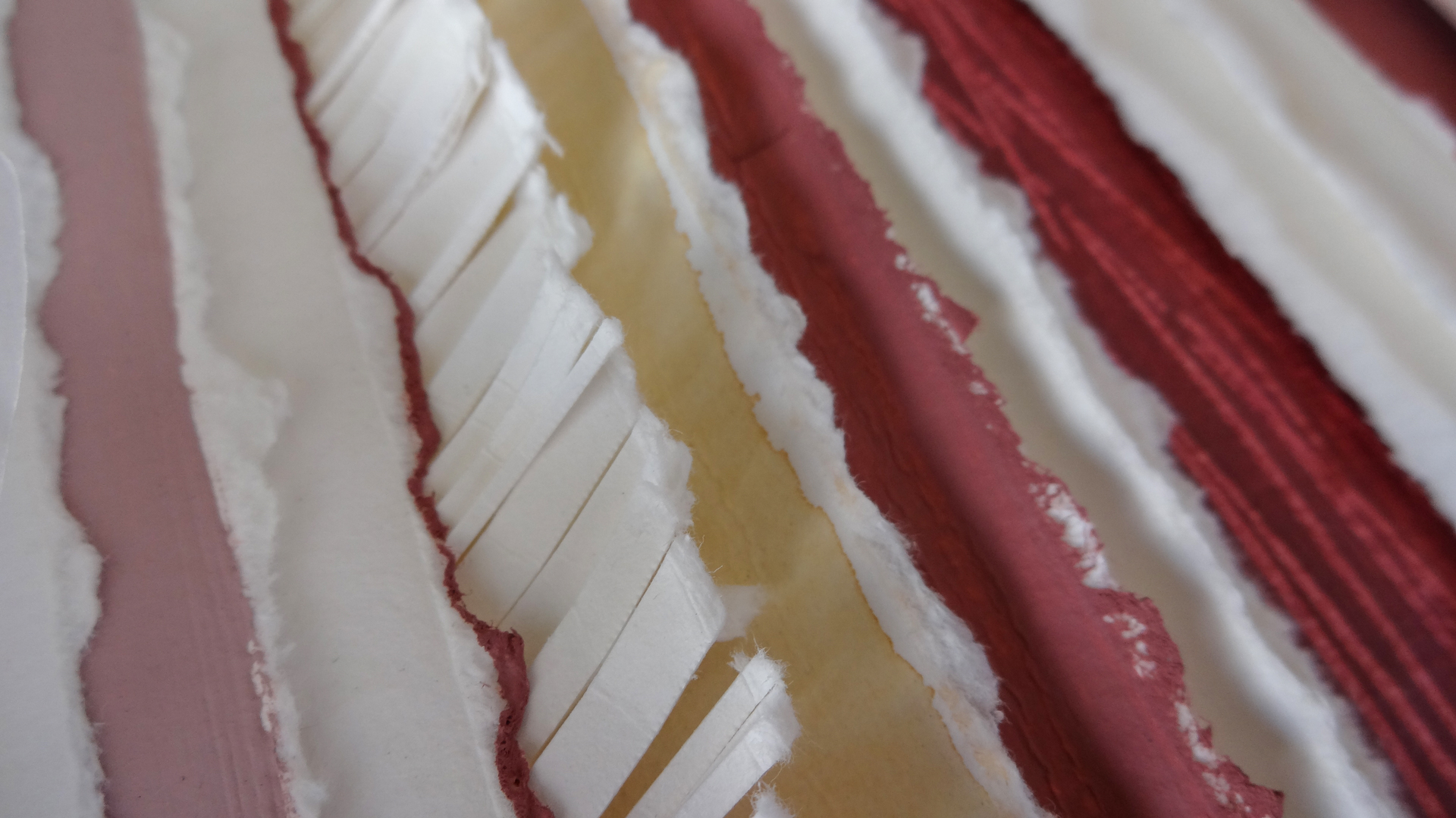
Studio process studies
surface tests exploring lamella construction, staining, and material erosion
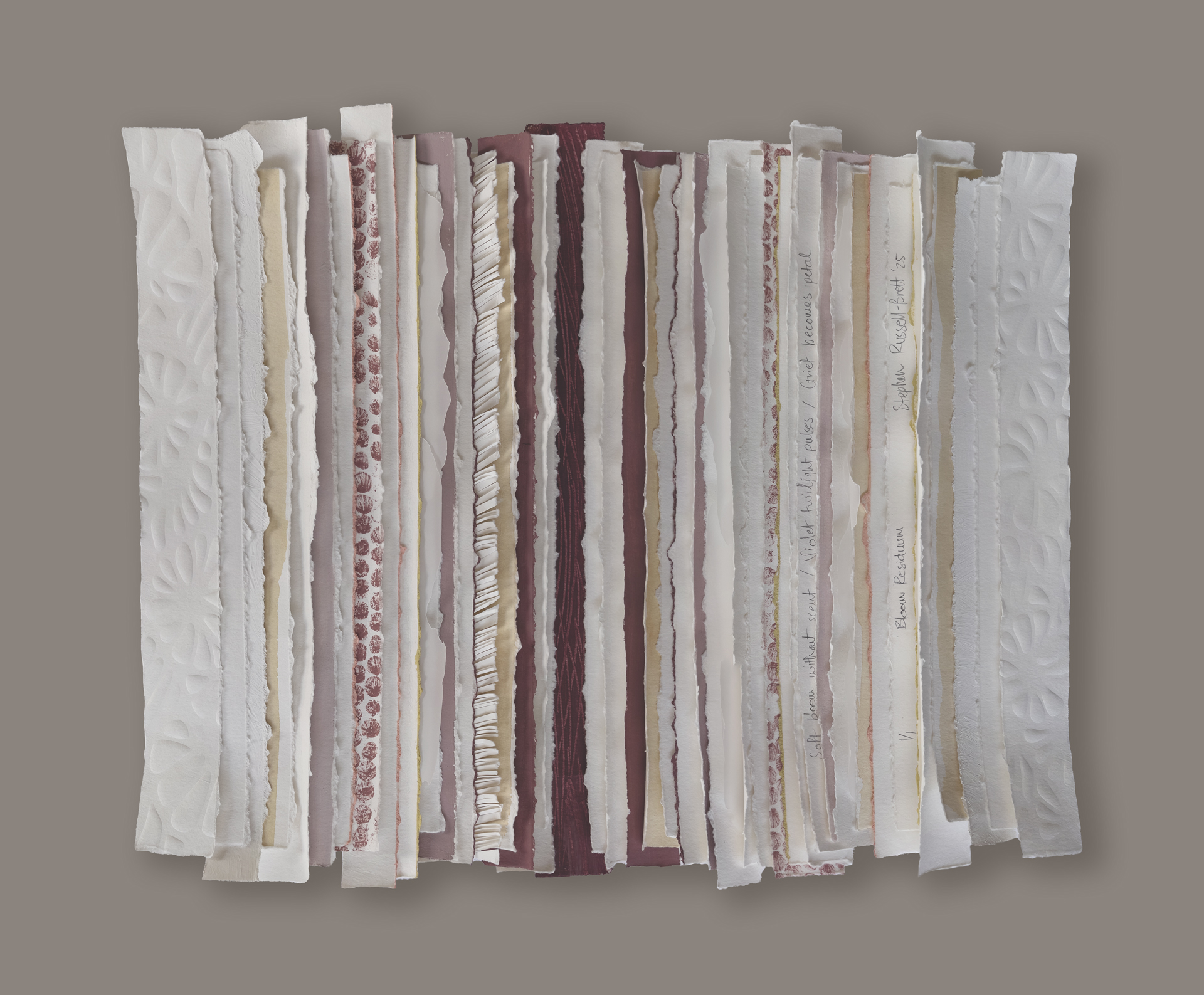
Spectral Taxonomy
layered paper lamellae with pigment and water staining
After Bleaching
When coral bleaches, the calcium architecture persists for a time – ghosted structures exposed, fragile, no longer protected by living tissue. Recovery remains possible only if conditions stabilize. Collapse follows if they do not.
Veil of Erasure exists in that interim state. Paper skeletons. An archive formed after damage but before resolution.
The work was completed in 2025. Since then, additional bleaching events have occurred. The rhythm has continued to fracture. This is not failure of the work,it is confirmation of its premise. Mujō does not wait for documentation to catch up.
The archive is already incomplete.
135 lamellae hold a moment of compression.
Four elevation levels hold shifting light.
Four voids mark absence.
Three fragments of haiku wait to be discovered.
Two red interruptions refuse closure.
One breath remains held, between data and grief.
The work does not preserve what is disappearing.
It records the conditions under which disappearance accelerates.
Documentation as lament.
Material as witness.
The archive carries the wound it records.
View the complete work: stephenrussellbrett.com/veil-of-erasure
Veil of Erasure (2025) received Merit Award at the Luxembourg Art Prize 2025, recognized for “making temporal acceleration visible through material fragility.”
For acquisition or exhibition inquiries: hello@stephenrussellbrett.com
< Previous Entry
Fractured Liminality: Folding, Fragmentation, and the Construction of Memory
Next Entry >
Finding Treasure in the Scraps