
Bloom Residuum
Spectral Taxonomy · 2025
Bloom Residuum remains with colour at the threshold of disappearance, where mauve, pink and violet persist as residue rather than certainty.
Forty-seven hand-torn lamellae carry botanical staining, embossing and transparent washes of ink and acrylic. Their warmer register holds the chromatic intensity of coral life in tension with the bleaching that can drain it away.
The work asks how colour itself might become a form of witness.
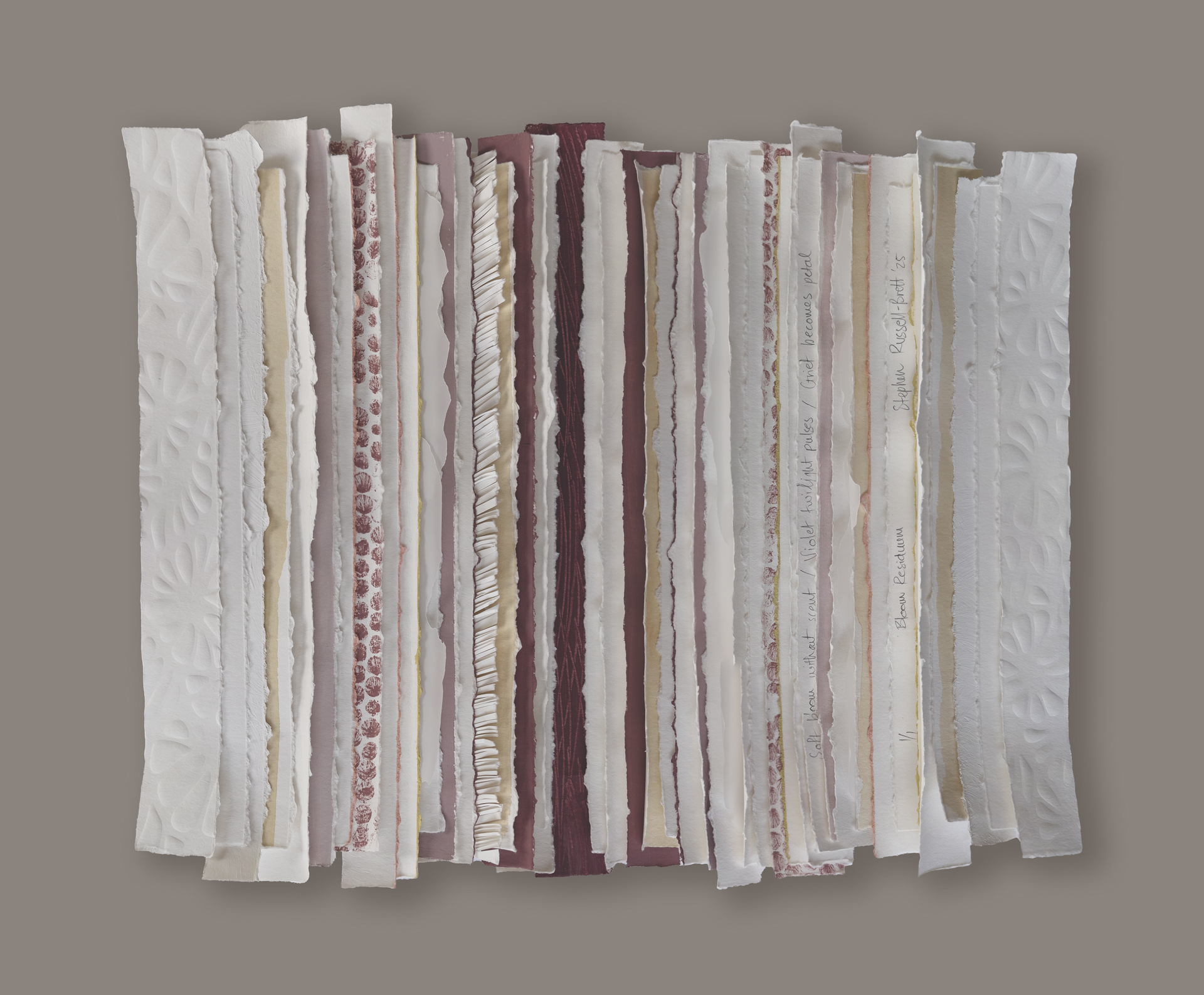
Bloom Residuum · Spectral Taxonomy · 2025

Bloom Residuum · Gallery view · 2025
At a glance
Collection
Spectral Taxonomy
Year
2025
Medium
Paper sculpture
Mixed media on Hahnemühle Britannia 300gsm and vellum archival paper
Artwork dimensions
50 × 42 cm
Framed dimensions
70 × 62 cm
Weight
9.3 kg with glass
Components
47 hand-torn lamellae
Edition
Unique work
Status
Available
About the work
Bloom Residuum occupies a warmer register within Spectral Taxonomy. Mauve, pink and violet gather across forty-seven paper lamellae, holding colour at the point where vitality, memory and disappearance begin to overlap.
Each sheet is torn by hand, stained with rooibos, green and black teas, embossed and then worked with transparent washes of mauve and pink inks and acrylics. The surfaces do not respond uniformly. Some absorb pigment deeply, others resist it, while occasional chromatic traces appear unexpectedly. Difference is allowed to remain visible across the field.
The fugitive associations of mauve are central to the work. Colour becomes less a fixed description than something vulnerable to time, light and exposure. Rather than presenting bleaching as a single event, the work attends to the unstable passage between chromatic intensity and its withdrawal.
The composition moves from left to right through an irregular rhythm. Golden-ratio spacing supplies an underlying order, but the lamellae resist complete regularity. Edges lift, settle and fray; embossed structures catch light differently; individual sheets maintain their own material behaviour.
The work brings the chromatic vitality associated with coral spawning into tension with bleaching, allowing abundance and ecological stress to occupy the same visual field. Colour is therefore neither decorative nor illustrative. It becomes evidence of a condition that can change.
On a single lamella, written in graphite, the haiku reads:
Soft bloom without scent
Violet twilight pulses
Grief becomes petal
The text remains quiet within the work, a small articulation embedded within the larger material field.
Bloom Residuum asks what remains perceptible while change is still taking place. Its mauves and pinks are not simply residues of something lost. They hold the viewer within the moment when colour is still present, still vulnerable and still capable of being witnessed.
Details

Bloom Residuum · Detail · 2025

Bloom Residuum · Detail · 2025

Bloom Residuum · Detail · 2025

Bloom Residuum · Detail · 2025
Technical information
Medium: Paper sculpture; mixed media on Hahnemühle Britannia 300gsm and vellum archival paper
Artwork dimensions: 50 × 42 cm
Framed dimensions: 70 × 62 cm, shadow box with glass
Weight: 9.3 kg with glass
Components: 47 hand-torn lamellae, horizontally arranged
Edition: Unique work
Year: 2025
Techniques: Tea staining using rooibos, green tea and black tea; transparent mauve and pink ink and acrylic washes; embossing; strategic tearing
Presentation: Shadow box with glass and taupe backing
Presentation
Recommended conditions
- Neutral wall colour, preferably white or pale grey
- Natural daylight or warm LED lighting
- Minimum viewing distance of 1 m for the full composition, with closer inspection encouraged
- Climate-controlled environment appropriate for works on paper
Exhibition readiness
- Professional photography and documentation available
- Certificate of authenticity included
- Framing meets museum archival standards
- Shipping-crate specifications available on request
Scale and installation

Bloom Residuum with Ultramarine Requiem · Scale view

Bloom Residuum · Artist impression