
Veil of Erasure: 135 Months, 135 Breaths
The first time I saw 135 as more than a number, I was standing in my studio surrounded by printouts of coral bleaching timelines. Global events, regional collapses, years that refused to behave like stable intervals. The gaps stretched, then snapped shut.
My breathing changed. Not because the number was large, but because it was small. What should be measured across long ecological durations had compressed into the scale of a human life.
Rather than treating the intervals as a statistical average, I compressed them into 135 lamellae, a mnemonic unit of loss rather than a chronological one. A structure to hold what numbers alone could not.
The violence was not only the bleaching. It was the acceleration. Geological time had begun to feel biographical.
135 became a heartbeat. A structure. A breath I could not release.
Veil of Erasure began there, in the space between data and grief.
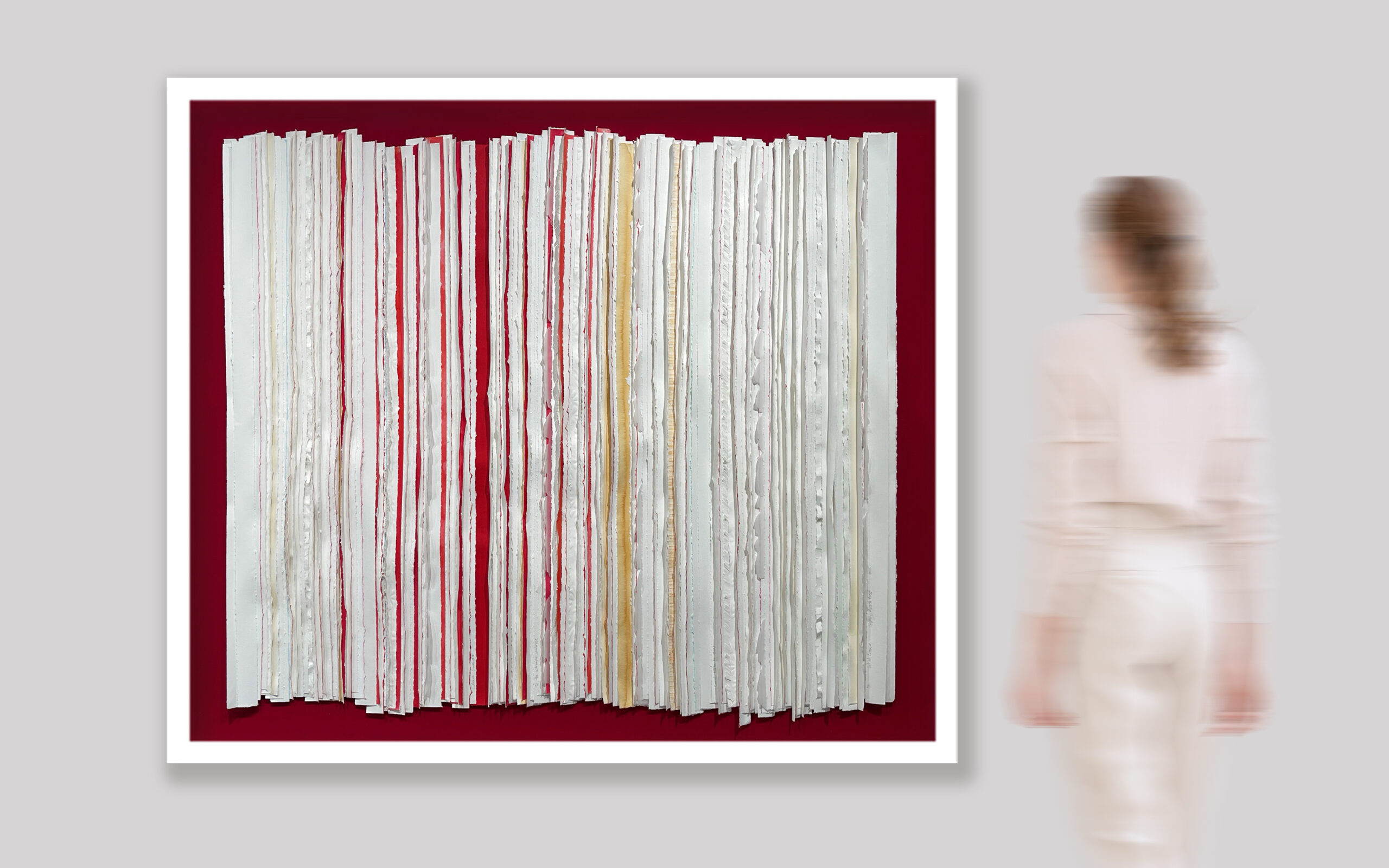
Veil of Erasure · Spectral Taxonomy · 2025
135 hand-altered paper lamellae suspended within a deep shadow box
When Paper Becomes Reef
I had worked with paper for years, but Veil demanded something different. Not paper as substrate. Paper as participant.
Paper, like coral, is lamellar. It is built in layers and carries marks of its making. It responds to water, heat and pressure. It can buckle, stain, bleach and tear. The material parallel became less metaphor than correspondence.
Hahnemühle Britannia 300gsm became the primary substrate because water damage remains physically legible in its surface. Fibres swell, buckle and hold the memory of liquid encounter. Vellum was introduced for a different response: cleaner tearing, greater translucency and a more surgical edge.
Each of the 135 lamellae underwent processes intended not to illustrate coral stress, but to allow the paper itself to register pressure and change.
Tea staining
Strong tea stains the paper slowly. Tannins oxidise over time, accumulating as discolouration rather than sitting cleanly on the surface. Some lamellae were stained once. Others were returned to repeatedly, building layers of exposure.
Later, rooibos introduced a deeper burnt-umber register across selected sheets. The colour functions as a temporal record, not decoration.
Gesso and calcification
Gesso builds white-on-white relief across selected surfaces. Its thickness catches light differently from the paper beneath it, suggesting the calcified architectures that remain when living tissue is lost.
Embossing
Blind embossing presses raised structures into dry paper. Some impressions remain shallow while others require far greater pressure. The resulting architectures become visible only when light moves across them.
The pressure is part of the process. The paper remembers.
Restrained colour
Blue-green traces appear on only a small number of sheets through highly diluted washes and transparent edge staining. They operate as residual colour, a memory of chromatic vitality within an increasingly pale field.
Strategic tearing
Tearing was the most difficult process to learn. It feels violent, but the work needed failure to remain visible. I tore at points already weakened by water, pressure or embossing, allowing the material to give way where stress had accumulated.
Some sheets remain largely intact. Others barely hold together. The field requires both, the not-yet-broken and the already-gone.
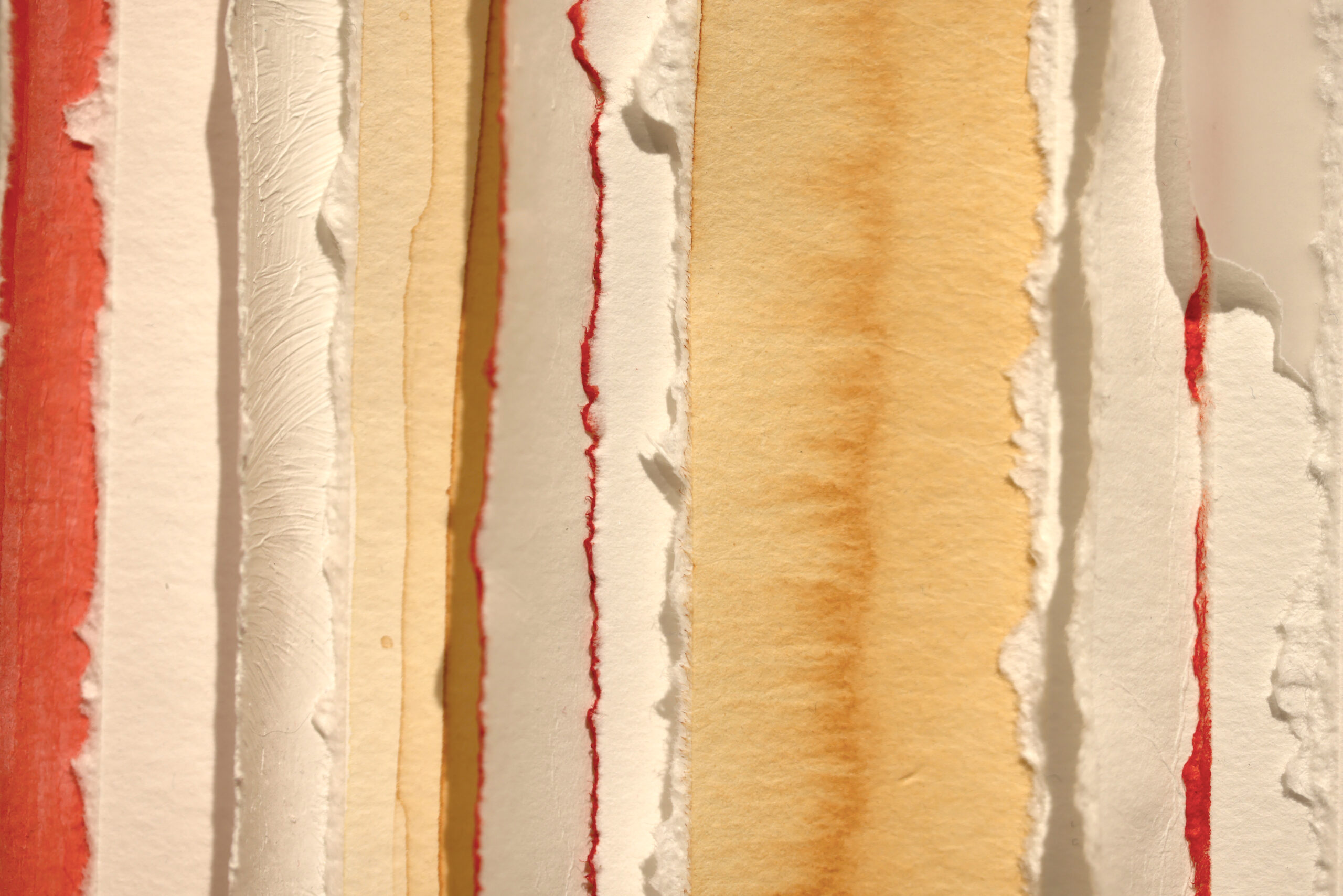
Material behaviour under stress
Water, pressure, tearing and surface alteration
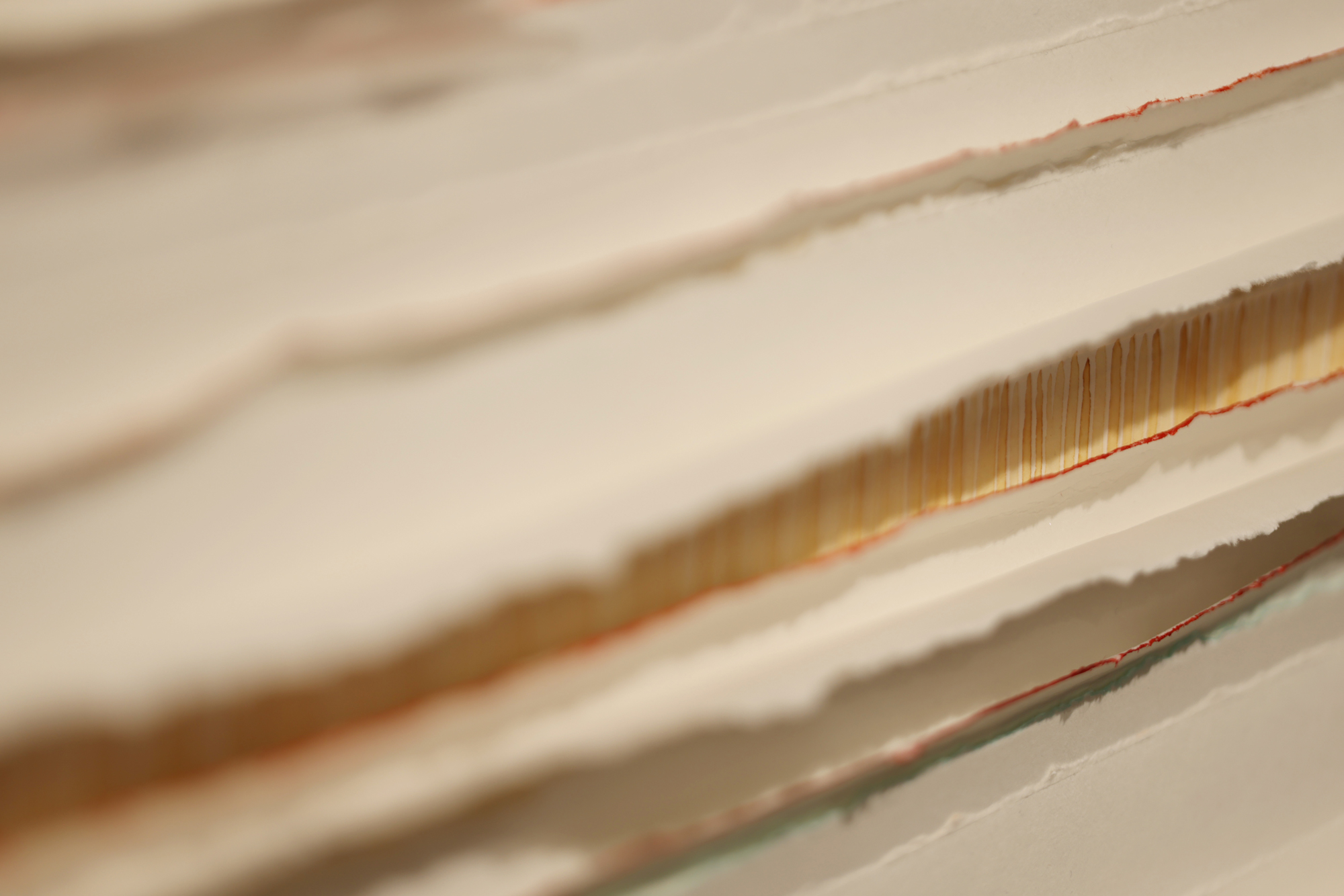
Material behaviour under stress
Embossing, staining and surface erosion
The Architecture of Absence
There are 135 lamellae, each approximately 123 × 4cm, though dimensions shift through tearing. They are suspended within a 170 × 154 × 7.5cm shadow box against red cotton backing.
The red took months to resolve. Not crimson. Not scarlet. Something between arterial colour and warning.
The lamellae float against this ground. Their fixings remain hidden so the construction recedes and the field appears suspended. As light moves, shadows change. What appears flat begins to reveal depth.
Four elevation levels
The lamellae occupy four depths: a base layer against the backing, then elevations at approximately 3mm, 5–7mm and 8–12mm forward.
This layering prevents the work from resolving from a single viewpoint. Some sheets catch direct light while others sit behind them in shadow. The viewer must move to see the structure change.
Four negative spaces
At positions 29, 43, 88 and 98, the field opens into absence. No lamella occupies the space. The red ground becomes visible as a compositional void.
Loss appears as gap.
Two red interruptions
Most of the field remains pale: tea-stained whites, bone, cream and restrained traces of blue-green. Two interruptions resist that continuity.
At position 51, close to the reciprocal golden-ratio point, a red lamella interrupts the bleached field. Its surface is comparatively flat and stripped of relief. At position 83, close to the golden-ratio point, another interruption appears through a rooibos-stained lamella torn back to expose a raw pale edge.
These placements hold rupture within order. They operate as both wound and warning, moments where the apparent stability of the field gives way.
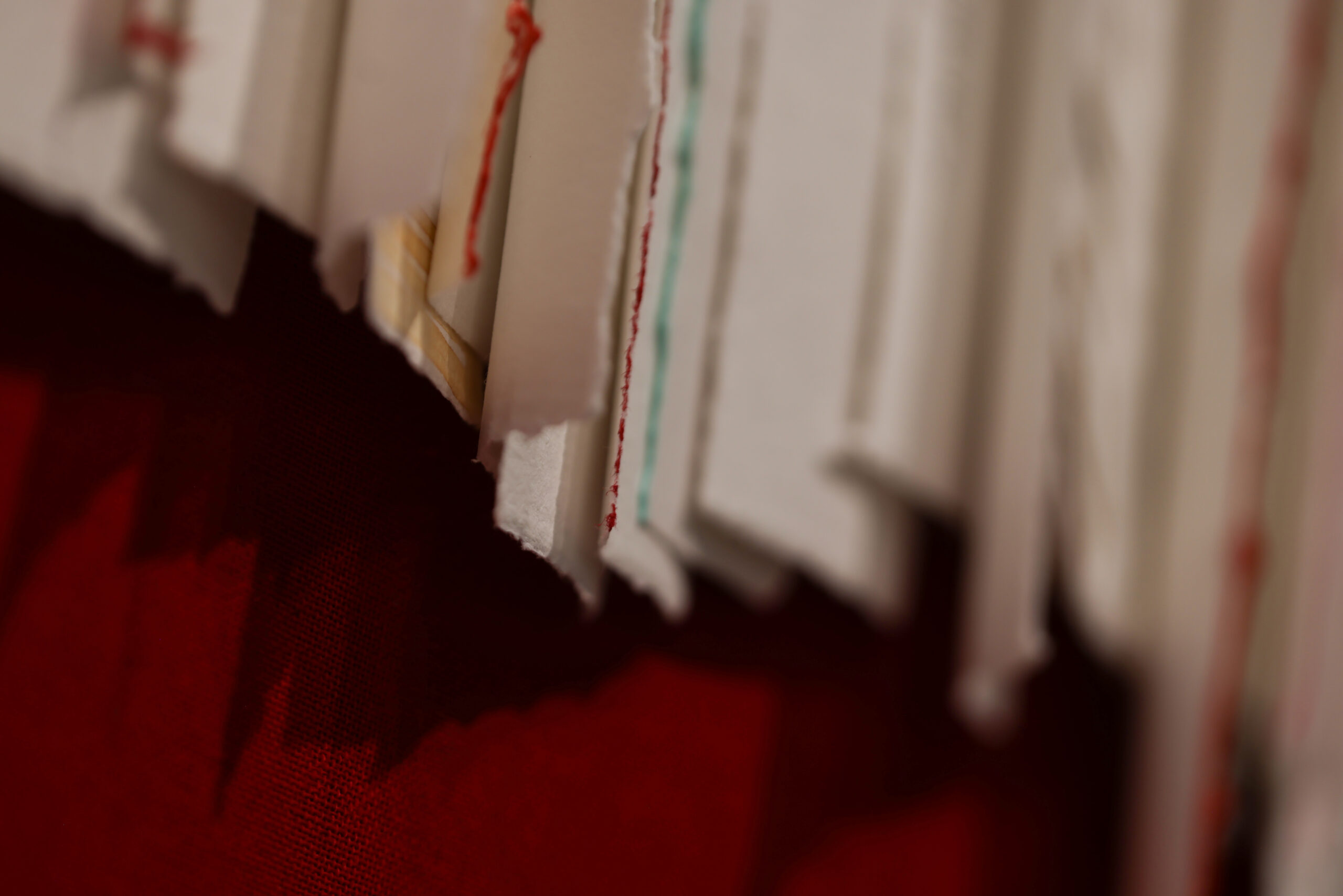
Veil of Erasure, detail
Lamellae field against red cotton ground
Three Breaths of Text
Hidden across three lamellae, at positions 50, 63 and 99, is a haiku. The words are embossed into the surface and remain almost invisible unless the viewer moves close enough for light to reveal them.
Colours surrender
To the warming embrace
Coral turns to ghost
I wrote the text after reading about zooxanthellae expulsion, the moment when coral loses the algae that gives it much of its colour and energy. “Warming embrace” is deliberate irony. The ocean that sustains can also become the condition of stress.
The haiku fragments across three sheets at irregular intervals. It must be discovered rather than announced. The constraint of the form matters: there is no room to explain everything.
Sometimes grief needs a structure that can hold without overflowing.
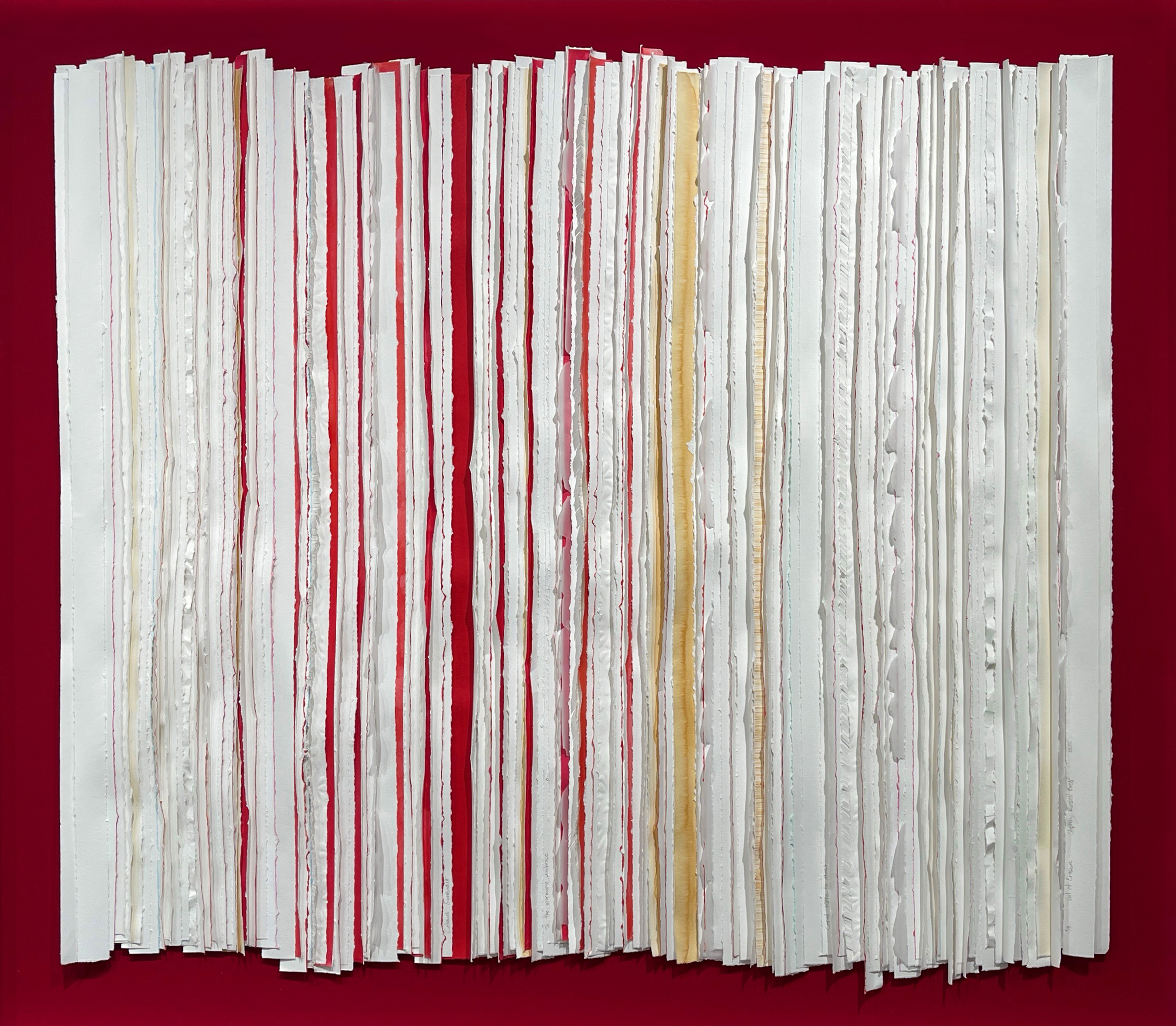
Lamellae field against red ground
Light reveals the different elevation levels across the surface
Mujō: Impermanence as Practice
While researching Japanese paper traditions, I encountered the concept of mujō (無常), usually translated as impermanence or transience. It names the recognition that things do not remain fixed.
Mujō is not pessimistic. It is an acknowledgement that change and loss are built into material existence.
This became important to Veil of Erasure. The work does not attempt to preserve coral reefs symbolically. It creates a material condition in which fragility and change remain present.
The paper embodies that condition. Stains continue to oxidise. Edges will shift with time. Even under archival glazing, the work remains a material object with its own duration.
The archive is therefore not outside impermanence. It participates in it.
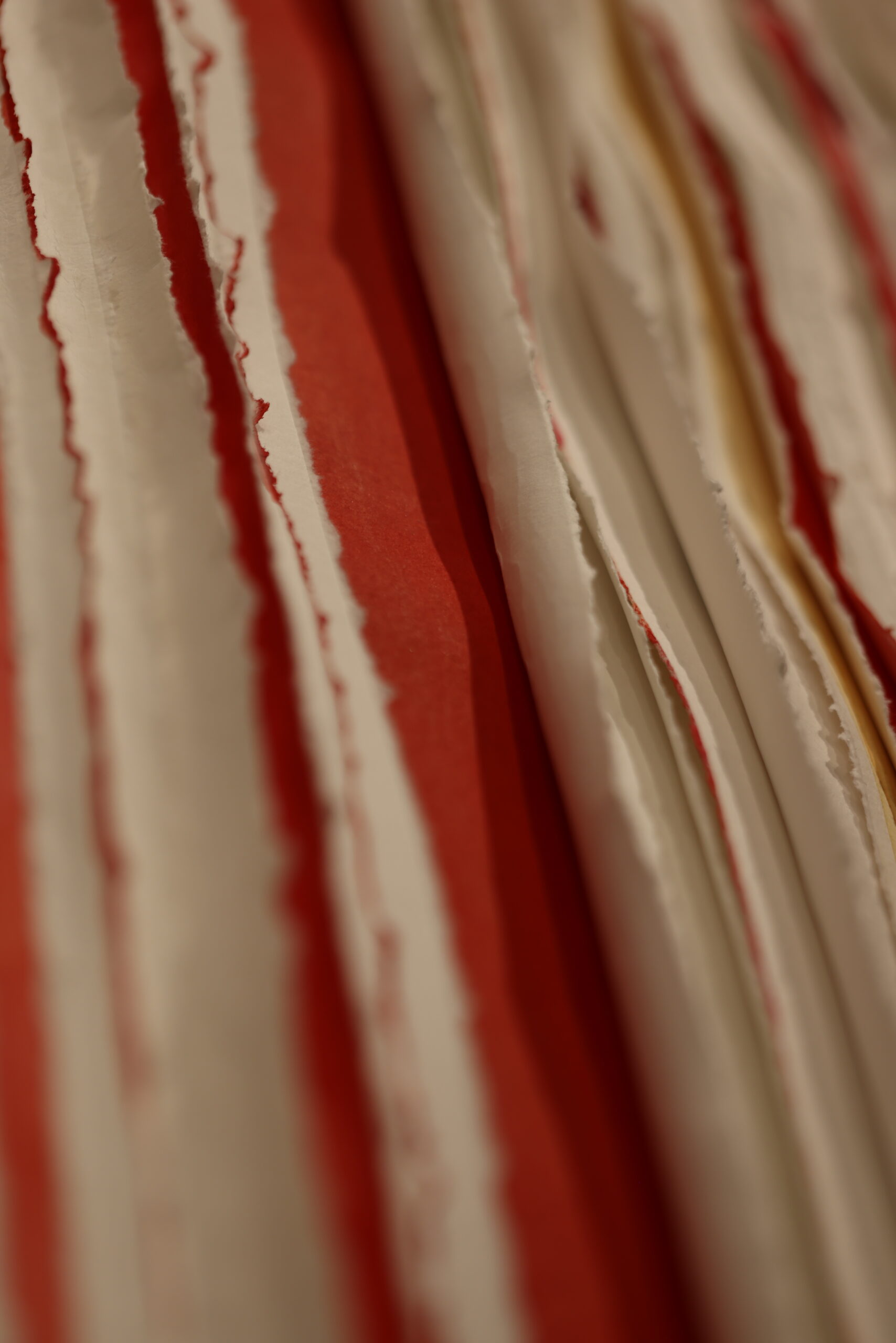
Veil of Erasure, close detail
Paper, pressure, staining and shadow
The Shadow Box as Threshold
The 7.5cm depth of the shadow box was a late decision that changed the work. A flat frame felt too close to illustration. Depth introduced an actual space.
You look into the work, not only at it. The lamellae occupy different planes and cannot be read completely from one angle. The viewer has to move, shift position and allow light to reveal what was hidden.
This physical encounter parallels the way loss is understood: partially, through return, and never all at once.
The glass creates a final boundary. It protects the surface, but it also separates the viewer from it. Reflections move across the work as the viewer moves. At moments, you see the lamellae and yourself looking at them at the same time.
The encounter remains one of proximity without access. You cannot touch. You can remain.
What the Work Asks
Veil of Erasure does not begin by asking for action or resolution. It begins with attention.
The viewer is invited to remain with 135 lamellae as a mnemonic compression of accelerating intervals. From a distance, the work reads as a pale ordered field. Closer looking reveals tears, staining, pressure, gaps and differences in elevation.
The work does not manufacture an emotional response. It creates the conditions in which one may occur.
Its invitation is simple: stay long enough for the apparent order to become unstable.
The Weight of Glass
The finished work weighs 37 kilograms with archival-grade glass, and 24.8kg without it.
Paper is expected to be light and ephemeral. But 135 sheets, applied gesso, a hardwood shadow box, cotton backing and glass accumulate into considerable mass.
I value that contradiction. The work is materially fragile, but physically heavy. It resists the idea that loss is weightless simply because it is difficult to see.
Data has weight. Grief has weight. Even absence, when given structure, accumulates.

Veil of Erasure, detail
Lamellae, surface pressure and shadow
Veil of Erasure, detail
Red ground and layered paper field
After Bleaching
When coral bleaches, its calcium architecture can persist for a time: ghosted structure exposed, fragile, no longer protected by living tissue. Recovery remains possible only if conditions change. Collapse follows if they do not.
Veil of Erasure exists within that threshold. Paper skeletons. A material record formed after damage but before resolution.
The work was completed in 2025. The ecological conditions it responds to did not stop when the final lamella was placed. Any archive of an accelerating event is incomplete almost as soon as it is made.
135 lamellae hold a moment of compression.
Four elevation levels hold shifting light.
Four voids mark absence.
Three fragments of haiku wait to be discovered.
Two red interruptions resist closure.
One breath remains held between data and grief.
The work does not preserve what is disappearing. It holds a moment in which acceleration became materially visible, then asks us to remain with it long enough to see.
Next entry →
Spectral Taxonomy: Translating Coral Collapse into Material Elegy